A Procedural Fairness Letter (PFL) in an Express Entry application is a notice from Immigration, Refugees and Citizenship Canada (IRCC) advising that an officer has identified concerns that could lead to refusal. Common concerns include work experience, misrepresentation, family composition, criminality, document authenticity, or eligibility issues. A PFL gives the applicant an opportunity to respond before a final decision is made.
Receiving a Procedural Fairness Letter in an Express Entry application is often one of the most stressful moments in the immigration process. An IRCC Procedural Fairness Letter is not a routine request—it usually means that an immigration officer has identified a concern that could result in an Express Entry refusal.
In many cases, the concern relates to work experience verification, family composition, criminality, document authenticity, application completeness and eligibility requirements, or potential misrepresentation. The purpose of a Procedural Fairness Letter Canada is to give the applicant an opportunity to respond before a final negative decision is made.
A Procedural Fairness Letter Express Entry situation should never be ignored. The consequences can be significant. Depending on the issue raised, an unresolved concern may lead not only to refusal, but also to a finding of misrepresentation under section 40 of the Immigration and Refugee Protection Act (IRPA), which can result in a five-year inadmissibility ban.
The good news is that receiving an Express Entry PFL does not automatically mean your application will be refused. Many applicants successfully overcome IRCC credibility concerns by providing additional evidence, clarification, and well-structured legal submissions that directly address the officer’s findings.
This article explains what a Procedural Fairness Letter Express Entry is, how it differs from an Additional Document Request (ADR), the most common triggers (including Express Entry work experience concerns and employment verification issues), relevant Federal Court decisions, and practical strategies for responding to a Procedural Fairness Letter effectively.
What Is a Procedural Fairness Letter?
A Procedural Fairness Letter (PFL) is a formal communication issued by Immigration, Refugees and Citizenship Canada (IRCC) when an officer has identified concerns that may lead to a negative decision but is required to give the applicant an opportunity to respond. In the context of an Express Entry application, an IRCC Procedural Fairness Letter is typically a warning sign that refusal is being considered.
The concept of procedural fairness is a fundamental principle of Canadian administrative law. Immigration officers must make decisions fairly and, in certain circumstances, provide applicants with a meaningful opportunity to address concerns before refusing an application.
The leading Supreme Court of Canada decision on procedural fairness is Baker v. Canada (Minister of Citizenship and Immigration),[1999] 2 SCR 817. The Court confirmed that the duty of fairness is flexible and depends on the circumstances of each case. Where a decision has significant consequences for an applicant, fairness may require that the applicant be informed of the officer’s concerns and be given a genuine opportunity to respond.
In the Express Entry PFL context, a Procedural Fairness Letter is commonly issued when an officer has concerns regarding:
- Claimed work experience or IRCC work experience verification
- Eligibility under the selected immigration program
- Authenticity of supporting documents
- Express Entry family composition issues
- Criminality or admissibility concerns
- Previous immigration history
- Potential Express Entry misrepresentation under section 40 of IRPA
A Procedural Fairness Letter Express Entry case is not a routine request for documents. Unlike an Additional Document Request (ADR), it usually indicates that the officer has already formed concerns and may refuse the application if those concerns are not adequately addressed.
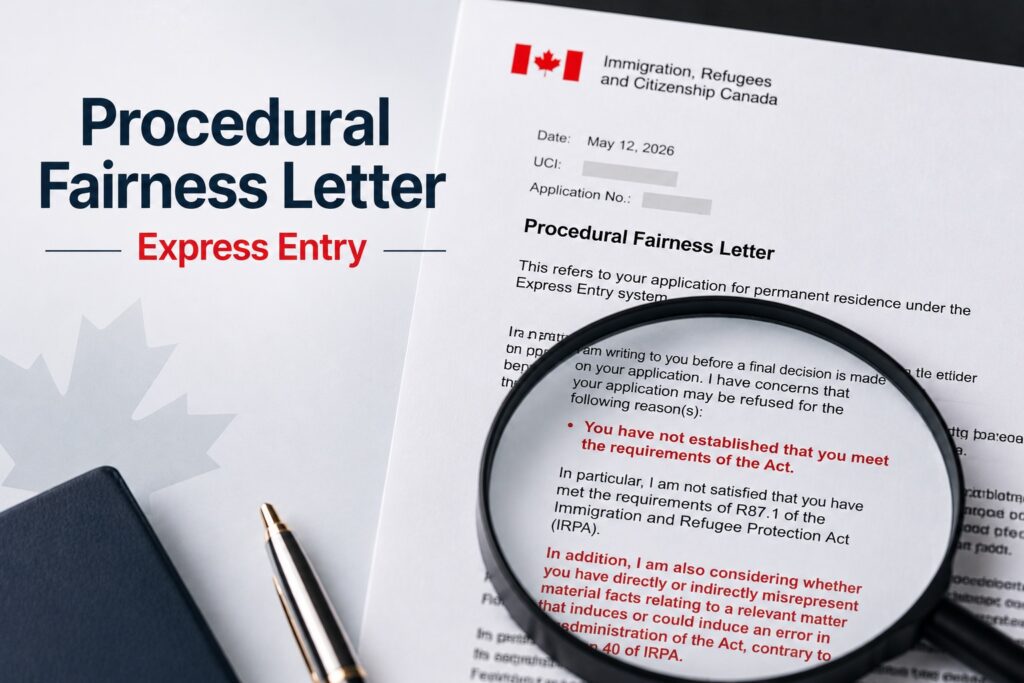
The following redacted example illustrates the type of language commonly found in an Express Entry Procedural Fairness Letter. Notice how the officer identifies the concern, cites the relevant provisions of the Immigration and Refugee Protection Act, provides a deadline to respond, and warns of the potential consequences if the concern is not adequately addressed.
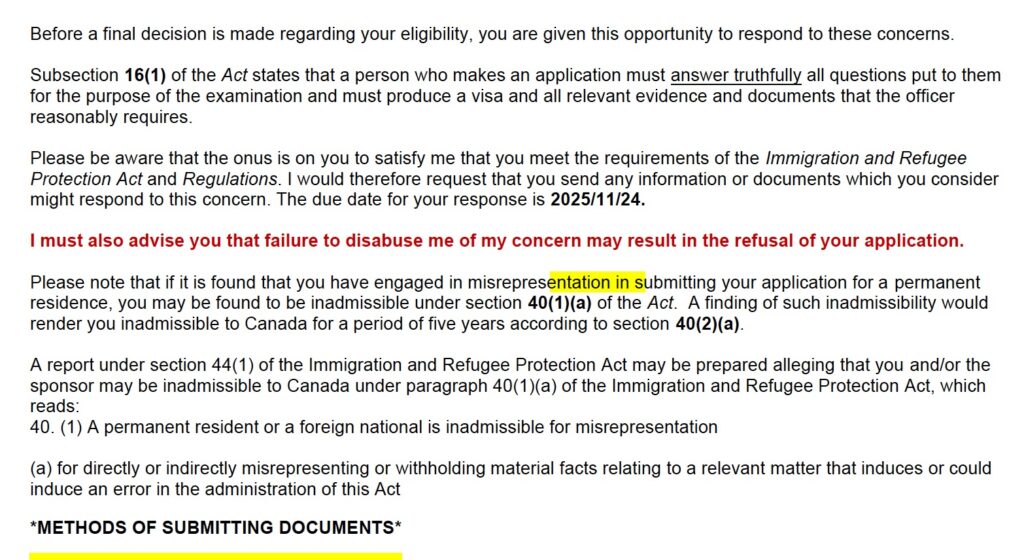
Several features commonly appear in a Procedural Fairness Letter:
- The officer clearly identifies the concern arising from the application
- References to relevant provisions of the Immigration and Refugee Protection Act or Regulations
- A specific deadline to respond, often ranging from a few days to several weeks
- A warning outlining the consequences if the concern is not resolved
Many Express Entry Procedural Fairness Letters reference section 16(1) of IRPA, which requires applicants to answer truthfully and provide all relevant evidence requested by an officer. Where credibility concerns arise, officers may also rely on section 40 of IRPA, which governs inadmissibility for directly or indirectly misrepresenting or withholding material facts.
A phrase frequently used in these letters is that the applicant must “disabuse” the officer of their concerns. This wording is significant. A proper response is not a repetition of previously submitted documents, but a targeted and evidence-based explanation that directly addresses the officer’s findings and resolves any IRCC credibility concerns.
For this reason, applicants should carefully analyze the Procedural Fairness Letter and identify the precise issue before preparing a response. A well-structured and timely reply can often determine whether an application proceeds to approval or results in an Express Entry refusal.
Procedural Fairness Letter vs Additional Document Request (ADR)
Many Express Entry applicants mistakenly assume that a Procedural Fairness Letter (PFL) and an Additional Document Request (ADR) are the same thing. While both involve a request from Immigration, Refugees and Citizenship Canada (IRCC), they serve very different purposes and should be approached differently.
An Additional Document Request (ADR) is generally a routine request for information or documentation that an officer requires before continuing the assessment of an application. In many cases, an ADR does not indicate that the officer has concerns about the applicant’s credibility, admissibility, or eligibility. Instead, the officer may simply require additional evidence to complete the assessment.
Common examples of ADRs include requests for:
- Updated police certificates;
- Additional passport pages;
- Updated proof of funds;
- Schedule A forms;
- Travel history documentation;
- Employment records or pay statements.
A Procedural Fairness Letter is considerably more serious. Unlike an ADR, a PFL is usually issued when an officer has identified a concern that may result in the refusal of the application. The purpose of the letter is to provide the applicant with an opportunity to address that concern before a final decision is made.
Common reasons for a Procedural Fairness Letter include:
- Work experience verification concerns;
- Questions regarding the authenticity of documents;
- Family composition issues;
- Criminality concerns;
- Potential misrepresentation;
- Concerns regarding eligibility under the Express Entry program.
A Procedural Fairness Letter should not be treated as a routine document request. In many situations, the response may require detailed explanations, supporting evidence, and legal submissions directly addressing the officer’s concerns.
| Additional Document Request (ADR) | Procedural Fairness Letter (PFL) |
|---|---|
| Routine request for information or missing documents | Serious concern identified by the officer |
| Usually does not indicate refusal risk | May lead to Express Entry refusal if concerns remain unresolved |
| Often straightforward response | Often requires detailed evidence, explanations, and legal submissions |
| Administrative in nature | Procedural fairness obligation engaged |
| Commonly requested: police certificates, proof of funds, passport pages | Common triggers: work experience verification, document authenticity, family composition, misrepresentation, eligibility concerns |
Understanding whether you received an Additional Document Request or a Procedural Fairness Letter Express Entry is crucial because the response strategy is fundamentally different.
- For an ADR, the applicant typically provides the requested information.
- For a PFL, the applicant must directly address the officer’s concerns, explain why the concern is unfounded, and provide evidence capable of persuading the officer not to refuse the application.
This distinction becomes especially important in Express Entry applications involving:
- Claimed foreign work experience or employment concerns
- Express Entry work experience concerns or IRCC employment verification issues
- Family composition disclosures and Express Entry family composition issues
- Allegations of Express Entry misrepresentation or credibility concerns
Failing to adequately respond to an IRCC Procedural Fairness Letter can result not only in refusal, but potentially in a five-year inadmissibility ban for misrepresentation under section 40 IRPA.
Common Reasons Express Entry Applicants Receive Procedural Fairness Letters
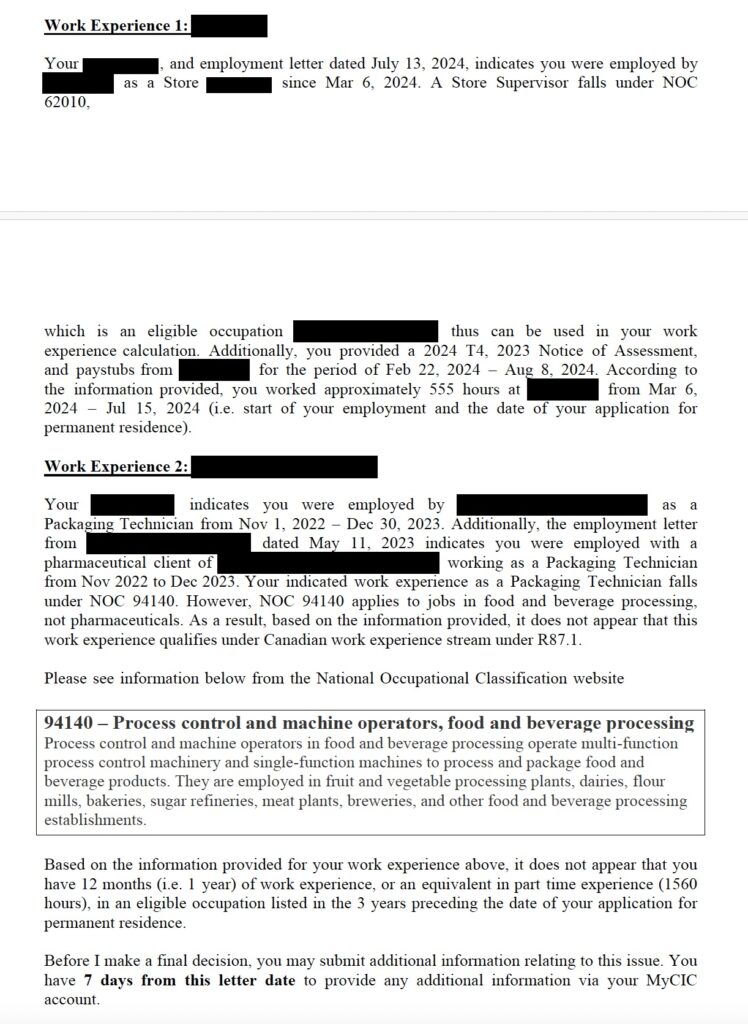
1. Work Experience Concerns
Work experience concerns are among the most common reasons applicants receive a Procedural Fairness Letter (PFL) in an Express Entry application. Because work experience frequently affects both program eligibility and Comprehensive Ranking System (CRS) points, Immigration, Refugees and Citizenship Canada (IRCC) closely examines whether the claimed employment genuinely occurred and whether it satisfies the requirements of the selected National Occupational Classification (NOC), including the lead statement and main duties associated with the occupation.
In many cases, the officer’s concern is not simply whether the employment existed, but whether the applicant has provided sufficient evidence to establish that the work experience qualifies for immigration purposes.
Common work experience concerns include:
- The employer cannot be independently verified;
- The business appears inactive or non-operational;
- The work location is unclear;
- The duties do not align with the selected NOC;
- Employment records conflict with payroll or tax documents;
- Foreign work experience cannot be verified;
- Salary records are inconsistent with the claimed employment;
- The applicant claimed continuous employment despite documented interruptions;
- The employer reference letter contains limited or generic information.
Credibility Concerns vs Insufficient Evidence
One of the most important distinctions in Procedural Fairness Letter cases is the difference between an officer finding that the evidence is insufficient and an officer questioning the credibility or authenticity of the evidence itself.
Where an officer simply concludes that an applicant has not provided enough evidence to establish eligibility, procedural fairness may not require the officer to provide an opportunity to respond. The burden remains on the applicant to submit a complete application and establish that all program requirements have been met.
However, where the officer questions the genuineness, credibility, or authenticity of the evidence, procedural fairness concerns may arise.
This distinction was discussed by the Federal Court in Hamza v. Canada (Citizenship and Immigration), 2013 FC 264. The applicant submitted an employment letter confirming his work as a physician and describing duties that closely mirrored the National Occupational Classification. The visa officer refused the application after concluding that the letter appeared “self-serving” and had been prepared specifically for immigration purposes.
The Federal Court found that the officer’s concerns went beyond a simple finding that the evidence was insufficient. By questioning the reliability and genuineness of the employer letter, the officer had effectively raised credibility concerns. In those circumstances, procedural fairness required that the applicant be given an opportunity to address the concerns before a refusal was issued.
The Court also confirmed that there is no rule preventing an employer reference letter from closely reflecting NOC wording where the duties genuinely describe the applicant’s actual employment. More importantly, the Court held that once an officer questions the credibility or reliability of an employment letter rather than simply finding the evidence insufficient, procedural fairness may require giving the applicant an opportunity to respond before refusing the application.
Employer Verification and Business Operations Concerns
IRCC frequently verifies employers and business operations when assessing Express Entry work experience claims. Concerns may arise where a company appears inactive, difficult to verify, or inconsistent with the information provided in the application.
In Singh v. Canada (Citizenship and Immigration), 2024 FC 1944, the applicant claimed CRS points based on Canadian work experience with a company operating as Student Nurses Canada. IRCC issued a Procedural Fairness Letter questioning whether the business was genuinely operating and requested additional evidence regarding its activities and ongoing operations.
Although the applicant provided corporate records, social media evidence, and supporting documentation, the application was refused. The Federal Court later set aside the refusal because the officer failed to meaningfully engage with the evidence submitted in response to the Procedural Fairness Letter. The decision serves as an important reminder that while applicants must provide evidence addressing officer concerns, officers must also properly assess that evidence and explain why it is insufficient before refusing an application.
Common Real-World Work Experience Issues
Work experience concerns often arise from issues that applicants do not initially recognize as problematic.
For example, some applicants work for large national employers with multiple locations. An employer reference letter may be issued by the company’s head office and confirm employment, but fail to identify the specific location where the applicant actually worked. In some cases, IRCC has issued Procedural Fairness Letters seeking clarification regarding the work location and employment history.
Similarly, applicants sometimes claim continuous employment while government records show periods during which Employment Insurance benefits were received following a workplace injury or temporary layoff. If those interruptions are not clearly explained, officers may question whether the applicant accumulated the qualifying work experience required under the program.
Foreign work experience may also receive increased scrutiny where the employer cannot be independently verified or where supporting evidence is limited. Because foreign work experience can significantly affect CRS points, officers may verify employers, review supporting payroll records, and assess whether the claimed duties align with the selected NOC before awarding points.
What Common Work Experience Issues Trigger a Procedural Fairness Letter?
Common work experience issues that may trigger a Procedural Fairness Letter in an Express Entry application include an employer that cannot be independently verified, a residential business address, an employer reference letter that does not identify the actual work location, duties that do not align with the selected NOC, payroll records that conflict with employment dates, interruptions in claimed continuous employment, undisclosed foreign work experience, and salary records that do not support the claimed occupation.
When Work Experience Concerns May Lead to Refusal
Receiving a Procedural Fairness Letter does not necessarily mean an application will be approved once a response is submitted.
In Kaur v. Canada (Citizenship and Immigration), 2026 FC 79, IRCC issued a Procedural Fairness Letter after identifying concerns regarding the applicant’s claimed work experience, including employer verification issues, wage inconsistencies, and concerns regarding the applicant’s qualifications for the position. Although the applicant responded to the Procedural Fairness Letter, the officer remained unconvinced that the claimed work experience had been established.
The Federal Court upheld the refusal and confirmed that the Procedural Fairness Letter provided an adequate opportunity to respond. The case illustrates that a PFL is not merely a procedural step; applicants must provide persuasive evidence capable of addressing the officer’s concerns.
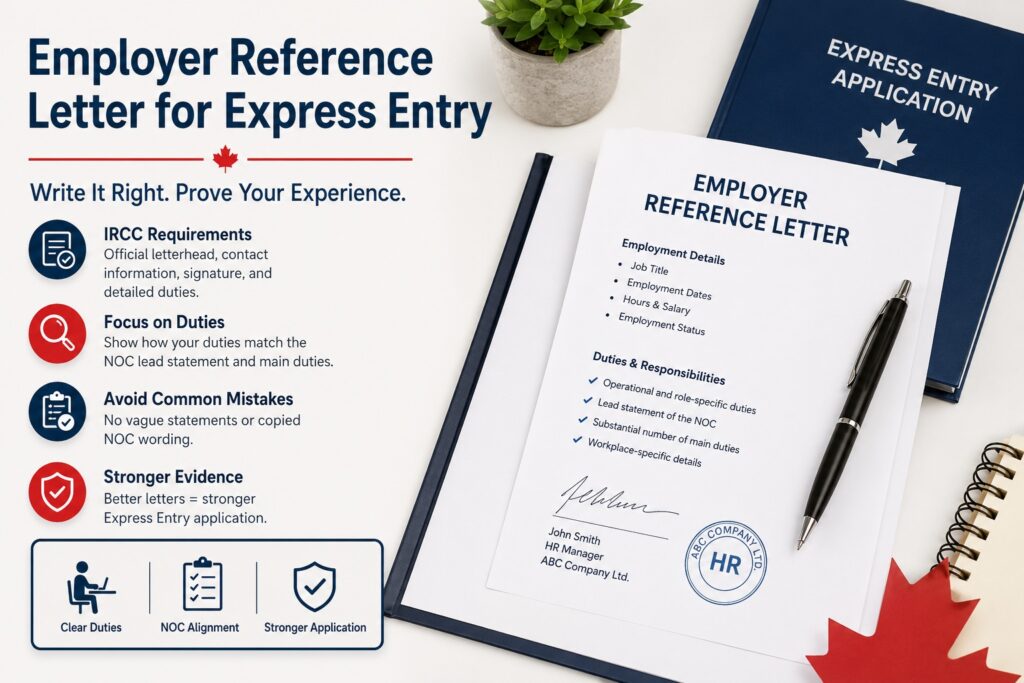
For this reason, applicants should ensure that employer reference letters, payroll records, tax documents, employment contracts, corporate records, and any other supporting evidence are consistent and capable of independently verifying the claimed work experience. Applicants should also carefully review their employer reference letters against the lead statement and main duties of the selected NOC before submitting an Express Entry application
Foreign Work Experience Concerns
Foreign work experience often receives greater scrutiny than Canadian work experience because it can be more difficult for IRCC to independently verify. Since foreign work experience may significantly affect both eligibility and Comprehensive Ranking System (CRS) points, officers may carefully examine the credibility of the claimed employment and supporting documentation.
Common concerns include:
- Employers that cannot be independently verified;
- Companies with little or no online presence;
- Salary records that do not support the claimed position;
- Inconsistencies between employment letters, tax documents, and payroll records;
- Foreign work experience that was not disclosed in previous immigration applications;
- Self-employment claims supported by limited documentary evidence;
- Duties that do not align with the selected NOC.
Unlike Canadian employment, foreign work experience often requires applicants to provide a broader range of supporting evidence. Depending on the circumstances, officers may review business registration records, tax documents, payroll records, contracts, invoices, banking records, social media presence, websites, and other documents demonstrating that the business genuinely operates and that the claimed employment actually occurred.
Undisclosed Foreign Work Experience
One issue that frequently arises in Express Entry applications is foreign work experience appearing for the first time after an Invitation to Apply (ITA) or not being disclosed in previous temporary residence applications.
The existence of previously undisclosed work experience does not automatically establish misrepresentation. However, officers may question why the employment was omitted from earlier applications and whether the information provided throughout the applicant’s immigration history is consistent and reliable.
Where such concerns arise, applicants should be prepared to explain the omission and provide documentary evidence supporting both the employment itself and the reason it was not previously disclosed.
What Foreign Work Experience Issues Commonly Trigger a Procedural Fairness Letter?
Foreign work experience concerns that may trigger a Procedural Fairness Letter include employers that cannot be independently verified, inactive or poorly documented businesses, salary records that conflict with employment claims, duties that do not align with the selected NOC, self-employment supported by limited evidence, and foreign work experience that was not disclosed in previous immigration applications.
Family Composition and Relationship Concerns
Family composition issues are becoming an increasingly common reason for Procedural Fairness Letters in Express Entry applications. Because family information affects admissibility, eligibility, future sponsorship rights, and the overall assessment of an application, IRCC carefully reviews an applicant’s marital status, relationships, and declared family members across all current and previous immigration applications.
A Procedural Fairness Letter may be issued where an officer identifies inconsistencies regarding a spouse, common-law partner, dependent child, or other family member. In many cases, the concern is not simply whether a relationship exists, but whether the information disclosed throughout the applicant’s immigration history is accurate and complete.
Common family composition concerns include:
- A common-law relationship that was not disclosed in previous applications;
- Different marital statuses declared across multiple applications;
- A spouse declared as single or omitted from prior applications;
- Accompanying and non-accompanying family member inconsistencies;
- Undeclared dependent children;
- Conflicting residential addresses suggesting cohabitation;
- Evidence indicating a relationship existed earlier than disclosed;
- Previous immigration records that do not match current family declarations.
Common-Law Relationship Concerns
One of the most frequent family composition issues arises where an applicant declares a common-law partner in an Express Entry application after previously identifying themselves as single in earlier immigration applications.
Officers may compare information from study permit applications, work permit applications, visitor visa applications, previous Express Entry profiles, and other immigration records to determine whether the declared relationship history is consistent.
Where evidence suggests that a common-law relationship existed earlier than disclosed, IRCC may question whether the relationship was accurately reported and whether any material information was withheld during previous applications.
Examples of evidence that may attract officer scrutiny include:
- Shared residential addresses;
- Joint bank accounts;
- Joint leases or utility bills;
- Insurance policies listing a partner as a beneficiary;
- Tax filings showing common-law status;
- Previous immigration applications containing inconsistent answers regarding marital status.
Accompanying and Non-Accompanying Family Members
Officers may also examine situations where a spouse or dependent child is declared as non-accompanying.
Declaring a spouse or child as non-accompanying is permitted under Canadian immigration law. However, IRCC may review whether the information provided regarding the relationship, living arrangements, and future plans is consistent with the evidence contained in the application.
Where an officer believes information regarding a spouse or family member has not been fully disclosed, concerns may arise regarding credibility, completeness, or potential misrepresentation.
Because this area continues to evolve, applicants should ensure that all family members are properly declared and that any decision to list a spouse or child as non-accompanying is supported by accurate and consistent information throughout the application.
What Family Composition Issues Commonly Trigger a Procedural Fairness Letter?
Family composition issues that may trigger a Procedural Fairness Letter include undisclosed common-law relationships, inconsistent marital status declarations, omitted spouses or dependent children, accompanying and non-accompanying family member discrepancies, conflicting residential histories, and previous immigration applications that do not match the family information disclosed in the current Express Entry application.
Misrepresentation Concerns
Misrepresentation concerns are among the most serious issues that can arise in an Express Entry application. Unlike many eligibility concerns that may result only in a refusal, a finding of misrepresentation can result in both refusal of the application and a period of inadmissibility under Canadian immigration law.
Under section 16(1) of the Immigration and Refugee Protection Act (IRPA), applicants must answer truthfully and provide any information and documentation reasonably required by an officer. In addition, section 40(1)(a) of IRPA provides that a foreign national may be found inadmissible for directly or indirectly misrepresenting or withholding a material fact relating to a relevant matter that induces or could induce an error in the administration of the Act.
Because of the serious consequences associated with a misrepresentation finding, IRCC will often issue a Procedural Fairness Letter before making a final decision. The purpose of the letter is to provide the applicant with an opportunity to address the officer’s concerns and explain why a finding of misrepresentation should not be made.
Common Misrepresentation Concerns in Express Entry Applications
Misrepresentation concerns may arise in a variety of circumstances, including:
- False or altered employment documents;
- Incorrect employment dates;
- Undeclared family members;
- Failure to disclose a common-law relationship;
- Inconsistent information across multiple applications;
- False education claims;
- Undisclosed refusals, criminal history, or immigration history;
- Information that conflicts with government records or previously submitted applications.
Importantly, misrepresentation does not always involve a forged document or deliberate deception. In some cases, IRCC may allege that an applicant omitted information or provided inaccurate information that could have affected the assessment of the application.
Not Every Inconsistency Is Misrepresentation
Applicants often assume that any inconsistency will automatically result in a finding of misrepresentation. However, the legal analysis is more nuanced.
In Lamsen v. Canada (Citizenship and Immigration), 2016 FC 815, the Federal Court set aside a misrepresentation finding where the officer focused on an inaccurate statement while failing to consider other documents in the application that accurately disclosed the relevant information and explained the discrepancy.
The Court’s decision serves as an important reminder that officers must assess the application as a whole. A single inconsistency does not automatically establish misrepresentation where other documents disclose the information, provide context, or explain the apparent discrepancy.
Nevertheless, applicants should never assume that IRCC will overlook conflicting information. Any inconsistency involving work history, family composition, education, immigration history, or admissibility should be addressed proactively and supported by documentary evidence wherever possible.
What Issues Commonly Trigger a Misrepresentation Procedural Fairness Letter?
Common issues that may trigger a misrepresentation Procedural Fairness Letter include false employment documents, incorrect employment dates, undisclosed spouses or dependent children, unreported common-law relationships, inconsistent information across immigration applications, undisclosed refusals or criminal history, and omissions that could affect the assessment of eligibility or admissibility.
Consequences of a Misrepresentation Finding
A misrepresentation finding can have significant consequences beyond the refusal of the current application. Depending on the circumstances, applicants may become inadmissible to Canada and face restrictions on submitting future immigration applications.
For this reason, any Procedural Fairness Letter alleging misrepresentation should be taken seriously. Applicants should carefully review the officer’s concerns, gather supporting evidence, address all discrepancies directly, and consider obtaining professional advice before submitting a response.
Does Every Concern Result in a Procedural Fairness Letter?
No. One of the most common misconceptions among Express Entry applicants is that IRCC must issue a Procedural Fairness Letter before refusing an application. In reality, not every concern requires procedural fairness.
The burden of proving eligibility always rests with the applicant. Applicants must provide sufficient evidence to establish that they meet the requirements of the immigration program under which they are applying. Where an officer simply concludes that the evidence is insufficient, incomplete, or does not satisfy the requirements of the Immigration and Refugee Protection Act or Regulations, a refusal may occur without a Procedural Fairness Letter.
This principle was recently reinforced by the Federal Court in Nanda v. Canada (Citizenship and Immigration), 2026 FC 649. The Court confirmed that procedural fairness is not automatically triggered whenever an officer reaches a negative conclusion. Where the issue is simply that the applicant has failed to establish eligibility based on the evidence provided, IRCC may refuse the application without first providing an opportunity to respond.
A Procedural Fairness Letter is more commonly required where the officer’s concerns involve:
- Credibility;
- Authenticity of documents;
- Accuracy of information;
- Possible misrepresentation;
- Concerns that go beyond a simple assessment of whether the evidence is sufficient.
Insufficient Evidence vs Credibility Concerns
The distinction between insufficient evidence and credibility concerns is one of the most important principles in Procedural Fairness Letter cases.
In Hamza v. Canada (Citizenship and Immigration), 2013 FC 264, the Federal Court explained that officers generally have no obligation to provide applicants with a “running score” of deficiencies in their application. Where evidence is simply insufficient, an officer may refuse the application without seeking additional information.
However, the Court also confirmed that procedural fairness concerns may arise where an officer questions the credibility, authenticity, or genuineness of the evidence itself. In Hamza, the officer described an employment letter as “self-serving” and appeared to doubt the truthfulness of the document. The Court found that these concerns went beyond simple evidentiary insufficiency and required an opportunity for the applicant to respond before a refusal was issued.
When a Procedural Fairness Letter May Not Be Required
In some cases, IRCC may refuse an application without issuing a Procedural Fairness Letter because the concern relates directly to the applicant’s failure to establish eligibility.
For example, where an applicant submits an employer reference letter that does not adequately describe their duties, fails to provide required supporting documentation, or does not establish that the claimed work experience satisfies the selected NOC, an officer may conclude that the applicant has simply failed to meet their burden of proof.
Similarly, where the evidence submitted does not establish the number of qualifying work experience hours, the period of employment, or another eligibility requirement, a refusal may occur without a Procedural Fairness Letter.
Conversely, where procedural fairness requires that an applicant be given an opportunity to respond, the officer must consider both the response and the supporting evidence before making a final decision. If the response does not adequately resolve the concerns identified, the application may nevertheless be refused.
Can Express Entry Be Refused Without a Procedural Fairness Letter?
Yes. Express Entry applications can be refused without a Procedural Fairness Letter where the officer concludes that the applicant failed to provide sufficient evidence to establish eligibility. A Procedural Fairness Letter is more likely where the officer questions the credibility, authenticity, or accuracy of the information provided, or is considering a finding of misrepresentation.
How Should You Respond to a Procedural Fairness Letter?
A Procedural Fairness Letter should never be ignored or treated as a routine document request. In many cases, the officer has already identified concerns that could lead to refusal of the application or, in more serious situations, a finding of misrepresentation.
The most effective Procedural Fairness Letter responses typically address both the facts and the law. Applicants should not only explain why the officer’s concerns are incorrect, but also provide documentary evidence supporting their position and address any relevant legal issues raised by the letter.
Step 1: Identify the Actual Concern
Before responding, carefully review the Procedural Fairness Letter and determine exactly what the officer is questioning.
For example, the concern may relate to:
- Work experience verification;
- Foreign employment claims;
- Family composition disclosures;
- Criminality concerns;
- Possible misrepresentation;
- Authenticity of documents.
Applicants should focus on the officer’s actual concern rather than what they believe the concern might be.
Step 2: Gather Supporting Evidence
The response should be supported by evidence wherever possible. Depending on the issue, relevant documents may include:
- Employer reference letters;
- Payroll records;
- Tax documents;
- Corporate records;
- Relationship evidence;
- Police certificates;
- Travel records;
- Affidavits or statutory declarations.
Documents should directly address the concern identified by the officer.
Step 3: Address Every Issue Directly
A common mistake is responding to only part of the Procedural Fairness Letter.
Applicants should address each concern individually, explain any discrepancies, and provide a clear chronology of events where timelines or facts are being questioned. Where an error occurred, it is often better to acknowledge the error and explain it rather than ignore it.
Step 4: Explain Inconsistencies and Provide Context
Not every inconsistency amounts to misrepresentation. If information appears inconsistent, applicants should explain why the discrepancy occurred and provide supporting evidence wherever possible.
In some situations, the issue may arise from a clerical mistake, misunderstanding, translation error, or information entered incorrectly by a third party. Where this occurs, applicants should clearly explain the circumstances and provide documentary evidence supporting the explanation.
Step 5: Consider the Legal Issues Raised
Where the Procedural Fairness Letter raises concerns regarding credibility, authenticity, or possible misrepresentation, the response may need to address the applicable legal principles in addition to the factual evidence.
This is particularly important where the officer is considering a finding under section 40 of the Immigration and Refugee Protection Act, as the consequences may extend beyond refusal of the current application.
Step 6: Consider Professional Assistance
Applicants should consider obtaining professional assistance where the Procedural Fairness Letter involves:
- Alleged misrepresentation;
- Foreign work experience concerns;
- Family composition issues;
- Criminality concerns;
- Complex credibility findings.
In these situations, the response may require both factual evidence and legal submissions addressing the officer’s concerns.
How Do You Respond to a Procedural Fairness Letter?
To respond to a Procedural Fairness Letter, applicants should identify the officer’s specific concerns, gather supporting evidence, address each issue directly, explain any inconsistencies, provide relevant documentation, and submit a complete response before the deadline. Where credibility or misrepresentation concerns are involved, legal submissions may also be required.
What Happens After a Procedural Fairness Letter Response?
After a Procedural Fairness Letter response is submitted, the officer will review both the response and the supporting evidence before making a final decision on the application.
There is no automatic outcome. Depending on the circumstances, the officer may:
- Accept the explanation and continue processing the application;
- Request additional information or clarification;
- Maintain the original concerns and refuse the application; or
- Make a finding of misrepresentation if the concerns remain unresolved.
The outcome often depends on whether the response directly addresses the concerns identified in the Procedural Fairness Letter and whether the supporting evidence adequately resolves those concerns.
Where the issue involves work experience, officers may review employer records, payroll documents, tax records, and other supporting evidence before determining whether the claimed experience qualifies under the selected NOC. Where family composition concerns exist, officers may assess relationship evidence, previous immigration applications, and supporting documentation to determine whether all relevant information has been accurately disclosed.
In cases involving potential misrepresentation, officers will assess whether the information provided was material to the application and whether the response adequately explains any discrepancies or omissions identified during processing.
Applicants should also remember that submitting a Procedural Fairness Letter response does not guarantee approval. The purpose of procedural fairness is to provide an opportunity to respond before a negative decision is made. The officer must still determine whether the concerns have been satisfactorily addressed based on the evidence before them.
Frequently Asked Questions About Procedural Fairness Letters in Express Entry
Does a Procedural Fairness Letter Mean Refusal?
No. A Procedural Fairness Letter does not automatically mean that an Express Entry application will be refused. It means that an officer has identified concerns that may lead to refusal and is providing the applicant with an opportunity to respond before a final decision is made.
How Long Do I Have to Respond to a Procedural Fairness Letter?
The response deadline depends on the specific letter issued by IRCC. Some Procedural Fairness Letters provide only a few days to respond, while others may provide several weeks. Applicants should carefully review the deadline stated in the letter and submit their response before the due date.
Can Express Entry Be Refused Without a Procedural Fairness Letter?
Yes. As discussed earlier, IRCC may refuse an application without issuing a Procedural Fairness Letter where the applicant has simply failed to establish eligibility or provide sufficient evidence. A Procedural Fairness Letter is more commonly required where credibility, authenticity, or possible misrepresentation concerns arise.
Can IRCC Accuse Me of Misrepresentation in a Procedural Fairness Letter?
Yes. Many Procedural Fairness Letters specifically advise applicants that IRCC is considering a finding of misrepresentation under section 40 of the Immigration and Refugee Protection Act. Because a misrepresentation finding can have serious consequences, applicants should carefully review the concerns raised and provide a complete response supported by evidence.
Should I Submit Additional Documents Even If They Were Not Specifically Requested?
In many cases, yes. If additional documents directly address the officer’s concerns, they may help clarify issues and strengthen the response. Applicants should focus on providing evidence that is relevant to the concerns identified in the Procedural Fairness Letter rather than submitting unnecessary documents.
Should I Get Professional Assistance Responding to a Procedural Fairness Letter?
Professional assistance may be beneficial where the Procedural Fairness Letter involves allegations of misrepresentation, foreign work experience concerns, family composition issues, criminality concerns, or complex credibility findings. The appropriate response often depends on the specific concerns raised by the officer and the evidence available to address them.
Conclusion
A Procedural Fairness Letter does not automatically mean that an Express Entry application will be refused. However, it is one of the most important communications an applicant can receive from IRCC because it indicates that an officer has identified concerns that may affect the outcome of the application.
Whether the concern relates to work experience, foreign employment, family composition, document authenticity, or possible misrepresentation, applicants should carefully review the allegations, gather supporting evidence, and provide a complete response that directly addresses the issues raised by the officer.
As the Federal Court has repeatedly emphasized, procedural fairness requires that applicants be given a meaningful opportunity to respond to certain concerns before a negative decision is made. At the same time, applicants bear the responsibility of providing sufficient evidence to establish their eligibility and address any concerns identified during processing.
Understanding the difference between a routine document request and a Procedural Fairness Letter, recognizing the legal issues involved, and responding effectively may significantly impact the outcome of an Express Entry application.
Disclaimer: This article is provided for general informational purposes only and does not constitute legal advice or create a consultant-client relationship. Immigration applications are assessed based on individual facts, evidence, and applicable law.
Received a Procedural Fairness Letter?
If you have received a Procedural Fairness Letter in an Express Entry application, professional guidance may help you understand the officer’s concerns, assess the strength of the evidence, and prepare an effective response within the required deadline.
Every case is different, and response deadlines are often short.
Express Entry • Work Experience Issues • Family Composition Concerns • Misrepresentation Allegations