Receiving an Invitation to Apply (ITA) through Express Entry does not guarantee permanent residence approval. Learn how A11.2 refusals occur, why IRCC reassesses CRS qualifications after ITA, and how weak employer letters, NOC issues, and credibility concerns can lead to refusal.
Receiving an Invitation to Apply (ITA) through Express Entry is often viewed as the final major step before Canadian permanent residence approval. However, many applicants are surprised to learn that receiving an ITA does not guarantee that the application will ultimately succeed.
After an electronic application for permanent residence (e-APR) is submitted, Immigration, Refugees and Citizenship Canada (IRCC) reassesses whether the applicant actually met the eligibility requirements and possessed the qualifications claimed in the Express Entry profile at the relevant stages of assessment.
This reassessment is commonly referred to as an A11.2 assessment, based on section 11.2 of the Immigration and Refugee Protection Act (IRPA).
A11.2 refusals have become a significant issue in many Express Entry applications involving:
- disputed work experience,
- weak employer reference letters,
- unsupported CRS claims,
- NOC mismatch concerns,
- inconsistent employment records,
- questionable self-employment claims,
- or broader credibility concerns identified during processing.
This is particularly common in applications submitted under the Canadian Experience Class where qualifying skilled work experience plays a central role in CRS eligibility.
Understanding how these refusals occur can help applicants prepare stronger applications and reduce unnecessary refusal risks after receiving an ITA.
What Is an A11.2 Refusal?
Section 11.2 of IRPA allows an officer to refuse a permanent residence application where the applicant:
- did not meet the requirements necessary to receive the invitation,
- did not possess the qualifications supporting the CRS points claimed,
- or no longer met the eligibility requirements connected to the invitation.
In practical terms, IRCC reassesses whether the applicant genuinely qualified for the ITA they received.
This means officers may later verify:
- work experience,
- NOC eligibility,
- language results,
- education credentials,
- arranged employment,
- provincial nomination validity,
- CRS calculations,
- and category-based eligibility requirements.
An application may still be refused even after an ITA is issued if the officer concludes that the points claimed in the Express Entry profile were not properly supported by the evidence submitted.
Why IRCC Reassesses Eligibility After ITA
Many applicants incorrectly assume that Express Entry eligibility becomes finalized once an ITA is issued. In reality, invitations are largely based on information self-declared by applicants in their Express Entry profile.
IRCC operational guidance specifically instructs officers to compare:
- the information declared in the profile at the time of invitation,
- and the evidence later submitted in the e-APR
to determine whether the applicant actually met the requirements of section A11.2.
The Ministerial Instructions governing Express Entry also confirm that:
- CRS rankings,
- invitations,
- and category eligibility
are initially based on the information declared in the profile itself.
After submission of the permanent residence application, officers review whether the supporting documents genuinely establish the qualifications claimed.
This is where many A11.2 refusals occur.
For example:
- an applicant may claim three years of foreign skilled work experience,
- but the employer letters may not properly establish the actual duties performed,
- the work may not sufficiently align with the selected NOC,
- or the records may contain inconsistencies affecting credibility.
If the officer removes those CRS points and the recalculated score falls below the invitation round cutoff, refusal may follow under A11.2.
Applicants Must Maintain Both Eligibility and CRS Qualifications
Under Express Entry, applicants must continue to meet:
- the Minimum Entry Criteria (MEC),
- and the qualifications supporting the CRS score that resulted in the ITA.
IRCC operational guidance confirms that applicants must maintain the qualifications that justified the invitation at the relevant assessment stages.
If an officer determines that:
- the applicant no longer met the program requirements,
- or did not actually possess the CRS qualifications claimed,
the application may be refused under section A11.2.
In many cases, officers recalculate the applicant’s CRS score after reviewing the supporting evidence. If the corrected score falls below the minimum score required in that invitation round, refusal may occur even after the ITA was issued.
Difference Between R10 and A11.2 Assessments
Many applicants confuse the later A11.2 eligibility assessment with the earlier R10 completeness check.
At the R10 stage, IRCC primarily verifies whether the required documents were submitted in the correct format at the time of application. The later A11.2 assessment focuses on whether the evidence actually establishes eligibility and the CRS qualifications claimed in the Express Entry profile.
| R10 Completeness Check | A11.2 Assessment |
|---|---|
| Verifies required documents were submitted | Verifies eligibility and CRS qualifications |
| Initial completeness review | Later substantive eligibility assessment |
| Focuses on document presence and format | Focuses on evidentiary sufficiency and credibility |
| Happens early after submission | Happens during processing |
| Passing R10 does not guarantee approval | A11.2 may still result in refusal |
Passing the R10 stage does not guarantee approval. An application may still later be refused under A11.2 if IRCC concludes that the supporting evidence does not sufficiently establish qualifying work experience, CRS eligibility, or program requirements.
Common Reasons for A11.2 Refusals
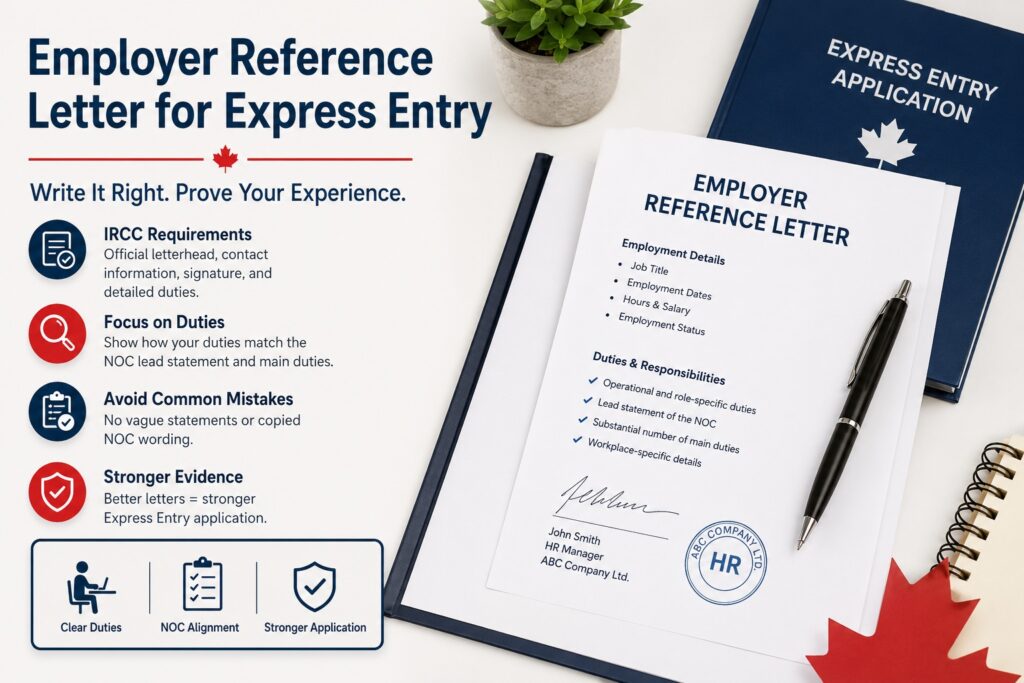
1. Weak or Incomplete Employer Reference Letters
One of the most common reasons for A11.2 refusal is insufficient employment evidence.
IRCC operational guidance specifically requires employer reference letters to contain:
- job title,
- duties and responsibilities,
- salary,
- hours worked,
- employment dates,
- and appropriate company and supervisor information.
Many refusals occur because employment letters:
- only confirm a job title,
- contain generic or templated duties,
- mirror NOC wording too closely,
- lack operational detail,
- or fail to explain the applicant’s actual day-to-day responsibilities.
In Ansari v Canada, 2013 FC 849, the Federal Court upheld a refusal where the officer concluded that the duties closely mirrored the NOC description and did not adequately establish the applicant’s real work experience. The Court confirmed that officers may treat generic or paraphrased duties as insufficient evidence without necessarily triggering procedural fairness obligations.
Applicants should remember that IRCC is not merely verifying whether employment existed. Officers are assessing whether the work experience actually qualifies under immigration law and the selected NOC.
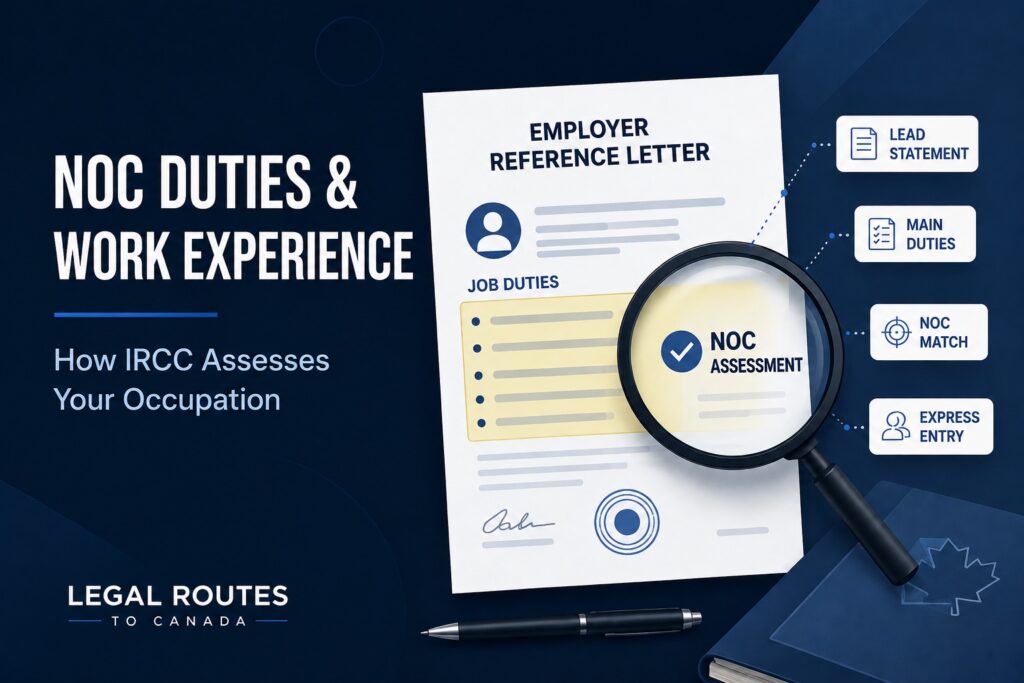
2. NOC Mismatch Concerns
A frequent issue in Express Entry refusals involves selecting an NOC that does not align with the actual duties performed.
Applicants should understand that IRCC assesses the actual duties performed rather than relying solely on job titles. Understanding how IRCC assesses NOC duties can help applicants select the correct occupation and avoid common refusal concerns.
IRCC officers compare:
- the employer reference letters,
- supporting documentation,
- and the National Occupational Classification (NOC) description itself
Problems commonly arise where:
- administrative duties are used to support professional NOCs,
- managerial titles lack managerial functions,
- technical occupations lack technical responsibilities,
- or the job descriptions appear artificially drafted to satisfy immigration requirements.
The Federal Court has also recognized that while some similarity between employer duties and NOC language is not unusual, generic descriptions lacking meaningful operational context may still create significant evidentiary concerns.
3. Unsupported CRS Claims
Applicants sometimes claim CRS points for:
- foreign work experience,
- Canadian work experience,
- arranged employment,
- language ability,
- education,
- or provincial nominations
without fully understanding the documentary burden required to support those claims.
If those qualifications cannot later be established through credible supporting evidence, officers may recalculate the CRS score during processing.
Where the recalculated score falls below the invitation round cutoff, refusal under A11.2 may follow.
4. Self-Employment and Work Experience Concerns
Certain forms of work experience receive increased scrutiny during Express Entry processing.
IRCC operational guidance specifically notes that self-declared duties or affidavits alone are generally insufficient to establish qualifying self-employment experience. Officers may instead examine:
- business ownership records,
- incorporation documents,
- payment records,
- tax filings,
- contracts,
- invoices,
- operational records,
- and third-party evidence confirming services performed.
Unsupported self-employment claims are frequently challenged because officers must determine whether the work was:
- genuine,
- skilled,
- authorized where required,
- and properly documented.
5. Credibility and Document Consistency Problems
A11.2 refusals are not always based solely on missing documents.
In many cases, the issue becomes credibility.
Officers may identify:
- inconsistent employment dates,
- conflicting salary records,
- unexplained work overlaps,
- suspiciously identical reference letters,
- discrepancies between profiles and supporting evidence,
- or documentation that appears unreliable.
Even where some evidence exists, officers may still conclude that the applicant failed to establish qualifying work experience on a balance of probabilities.
Do Changes After e-APR Submission Automatically Lead to Refusal?
Not necessarily.
IRCC policy guidance distinguishes between:
- changes that occurred before the e-APR was submitted,
- and changes arising after submission.
In many A11.2 assessments, officers focus primarily on whether the applicant:
- met the eligibility requirements at the time the ITA was issued,
- and continued to meet those requirements at the time the e-APR was submitted.
As a result, not every later change in employment or CRS circumstances automatically results in refusal under A11.2.
However, significant changes involving:
- arranged employment,
- eligibility requirements,
- admissibility,
- or material information
may still need to be disclosed to IRCC depending on the circumstances.
When Is Procedural Fairness Required in A11.2 Cases?
One of the most important legal issues in A11.2 refusals is whether IRCC must provide the applicant with an opportunity to respond before refusing the application.
The answer depends largely on the nature of the officer’s concern.
In many Express Entry refusals, officers conclude that the evidence submitted simply does not sufficiently establish the claimed work experience, CRS qualifications, or program eligibility requirements. In these situations, Federal Court jurisprudence has generally confirmed that officers are not always required to issue a Procedural Fairness Letter (PFL) before refusing the application.
For example, in Ansari v Canada, 2013 FC 849, the Federal Court upheld a refusal where the officer concluded that the employment duties closely mirrored the National Occupational Classification (NOC) language and did not adequately establish the applicant’s actual work experience. The Court distinguished between concerns involving insufficient evidence and concerns involving credibility or fraud, confirming that procedural fairness obligations may not arise where the issue is evidentiary insufficiency alone.
However, the legal analysis changes where the officer’s concerns move beyond insufficient documentation and into issues involving credibility, authenticity, or possible misrepresentation.
In Madadi v Canada, 2013 FC 716, the Federal Court recognized that where an officer effectively treats documents as unreliable or questions their genuineness, procedural fairness obligations may arise before refusal. In those situations, applicants may need to be given an opportunity to respond to the officer’s concerns before a negative decision is made.
The Federal Court has also recognized that some similarity between employer duties and NOC descriptions is not unusual in immigration applications. In Ghannadi v Canada, 2013 FC 515, the Court cautioned against treating every similarity to NOC language as “mindless copying” where the evidence still contains meaningful operational detail and workplace context.
This distinction is extremely important in Express Entry applications.
If an officer simply concludes:
“The documents submitted do not sufficiently establish qualifying work experience,”
a refusal under A11.2 may occur without additional warning.
But where the officer’s concerns effectively suggest:
- dishonesty,
- fabricated documentation,
- or credibility problems,
procedural fairness obligations may become significantly stronger.
A11.2 Refusal vs Misrepresentation
Not every A11.2 refusal results in a finding of misrepresentation.
Some applications are refused simply because the officer concludes that the applicant did not sufficiently establish the claimed qualifications or CRS points.
However, where officers believe:
- false information,
- misleading documentation,
- fabricated employment evidence,
- or intentional concealment
may be involved, concerns about misrepresentation under section 40 of IRPA may also arise.
This distinction is extremely important because misrepresentation findings can carry serious long-term immigration consequences beyond refusal alone.
How Applicants Can Reduce the Risk of an A11.2 Refusal
Ensure Employment Letters Are Detailed and Genuine
Strong employer reference letters should:
- accurately describe real duties,
- explain the operational environment,
- include salary, hours, dates, and position details,
- and remain consistent with supporting evidence.
Artificial or generic letters often create unnecessary refusal risks.
Maintain Consistency Across All Records
Officers frequently compare:
- Express Entry profiles,
- resumes,
- employer letters,
- tax records,
- payroll evidence,
- LinkedIn profiles,
- and prior immigration applications.
Even relatively small inconsistencies may trigger broader credibility concerns.
Avoid Claiming CRS Points That Cannot Be Properly Proven
Many refusals occur because applicants attempt to maximize CRS points without possessing sufficient documentary support.
Claiming experience or qualifications that cannot later be substantiated may create far greater risk than submitting a lower but accurate CRS profile.
Understand That the Burden of Proof Remains on the Applicant
In Express Entry applications, the burden remains on the applicant to establish eligibility.
IRCC officers are not required to search for missing explanations or infer qualifications that are not properly supported by the evidence submitted.
Minor discrepancies do not automatically result in refusal. However, where inconsistencies affect eligibility, CRS qualifications, or credibility, officers may proceed with reassessment under A11.2
Frequently Asked Questions About A11.2 Refusals
Can Express Entry be refused after an ITA?
Yes. Receiving an Invitation to Apply (ITA) does not guarantee approval. IRCC may later reassess whether the applicant actually met the eligibility requirements and possessed the CRS qualifications claimed in the Express Entry profile.
What is an A11.2 refusal?
An A11.2 refusal occurs when IRCC determines that the applicant did not meet the requirements necessary to receive the ITA or did not properly establish the CRS points claimed in the application.
Does IRCC always issue a Procedural Fairness Letter before refusing under A11.2?
No. Federal Court jurisprudence confirms that a Procedural Fairness Letter is not always required where the refusal is based on insufficient evidence rather than credibility or fraud concerns
Can weak employer reference letters cause Express Entry refusal?
Yes. Generic or poorly drafted employment letters may lead officers to conclude that the applicant failed to establish qualifying work experience under the claimed NOC.
Can CRS points be recalculated after ITA?
Yes. IRCC officers may reassess CRS qualifications during processing. If unsupported points are removed and the score falls below the invitation round cutoff, the application may be refused under A11.2
Final Thoughts on A11.2 Refusals
A11.2 refusals are often misunderstood because many applicants view Express Entry as a purely points-based system. In reality, permanent residence applications involve a detailed legal and evidentiary assessment.
An ITA is not final approval.
IRCC officers may still reassess:
- whether the applicant genuinely met the program requirements,
- whether CRS points were properly claimed,
- whether qualifying work experience has been sufficiently established,
- and whether the supporting evidence is credible and consistent.
Carefully prepared documentation, realistic CRS claims, detailed employer evidence, and consistency across the application remain critical to reducing refusal risks under section A11.2 of IRPA.
For applicants dealing with:
- complex work history,
- self-employment claims,
- weak employer documentation,
- NOC classification concerns,
- or credibility-related issues,
careful preparation before submission can become especially important.
Disclaimer: This article is provided for general informational purposes only and does not constitute legal advice or create a consultant-client relationship. Immigration applications are assessed based on individual facts, evidence, and applicable law.