The Express Entry R10 completeness check is one of the earliest and most important stages of a Canadian permanent residence application. During this stage, IRCC reviews whether all mandatory documents and required information have been properly submitted before the application proceeds to eligibility assessment.
Many Express Entry applicants believe that once they submit their permanent residence application, the most difficult part is over.
In reality, one of the first and most important stages of assessment is the Express Entry completeness check, commonly referred to as the R10 completeness check.
Before IRCC fully processes an Express Entry application, officers first review whether the application is complete under section 10 of the Immigration and Refugee Protection Regulations (IRPR). This stage is commonly referred to as the R10 completeness check.
At this stage, IRCC examines whether the required documents have been uploaded and whether the application contains sufficient mandatory documentation to proceed into processing.
This step is extremely important because incomplete applications can be rejected before eligibility is fully assessed.
Many applicants incorrectly assume that:
- uploading “something” is enough,
- passing R10 means approval is likely,
- or that completeness and eligibility are the same thing.
They are not.
A technically complete application can still be refused later if IRCC is not satisfied that the applicant genuinely meets the program requirements.
In this article, we will explain:
- what the Express Entry R10 completeness check is,
- what IRCC reviews during this stage,
- employer reference letter requirements,
- common work experience mistakes,
- completeness versus credibility,
- how R10 differs from A11.2 eligibility assessments,
- and common reasons applications are rejected or refused.
What Is the Express Entry R10 Completeness Check?
The Express Entry R10 completeness check is IRCC’s initial review of an electronic application for permanent residence (e-APR) to determine whether all required documents and mandatory information have been submitted.
At this stage, officers generally assess whether:
- required documents were uploaded,
- mandatory fields were completed,
- supporting evidence exists for claimed CRS points,
- and the application meets basic submission requirements.
If the application is considered incomplete, IRCC may reject it under section 10 of the Immigration and Refugee Protection Regulations before substantive processing begins.
IRCC’s official guidance on Express Entry completeness checks explains that officers initially assess whether all mandatory documents and required information have been properly submitted as part of the electronic application for permanent residence (e-APR).
Importantly, this stage is usually not a full credibility assessment.
IRCC guidance specifically notes that at the completeness stage, officers primarily determine whether the required documents are included. The deeper assessment of credibility, genuineness, and eligibility normally occurs later during processing.
That distinction is extremely important.
Many applicants pass the R10 completeness stage but later receive refusals because the officer is not satisfied that the documents genuinely prove the claimed work experience, education, or CRS points.
Why the R10 Completeness Check Matters
The completeness check is not simply administrative.
If IRCC determines that required documents are missing or insufficient at the R10 stage, the application may be rejected as incomplete.
When this happens:
- the application is not processed further,
- fees are generally refunded,
- and the applicant must submit a new Express Entry profile and wait for another Invitation to Apply (ITA).
This can create major problems if:
- CRS scores later increase,
- category-based draws change,
- age points decrease,
- work permits expire,
- or the applicant no longer qualifies under the same category.
For many applicants, avoiding an R10 rejection is critical.
What Documents Does IRCC Review During the Completeness Check?
IRCC reviews whether mandatory documents were provided for the applicant’s specific circumstances.
Depending on the application, this may include:
- passports,
- police certificates,
- medical examination confirmations,
- employer reference letters,
- proof of funds,
- education documents,
- language test results,
- marriage certificates,
- common-law evidence,
- work permits,
- and supporting civil status documents.
IRCC’s completeness guidance specifically notes that the personalized document checklist generated after receiving an ITA determines which documents are required for each applicant.
Some of the most important R10-related document issues involve:
- work experience proof,
- police certificates,
- and employer reference letters.
These are also some of the most common reasons applicants later face eligibility refusals under A11.2.
Employer Reference Letters and Work Experience Proof
Employer reference letters are among the most important documents in an Express Entry application because they directly affect:
- CRS points,
- program eligibility,
- NOC classification,
- and Canadian work experience assessment.
In practice, weak employer letters are one of the most common reasons applicants later face:
- A11.2 refusals,
- work experience disputes,
- procedural fairness concerns,
- or requests for additional evidence.
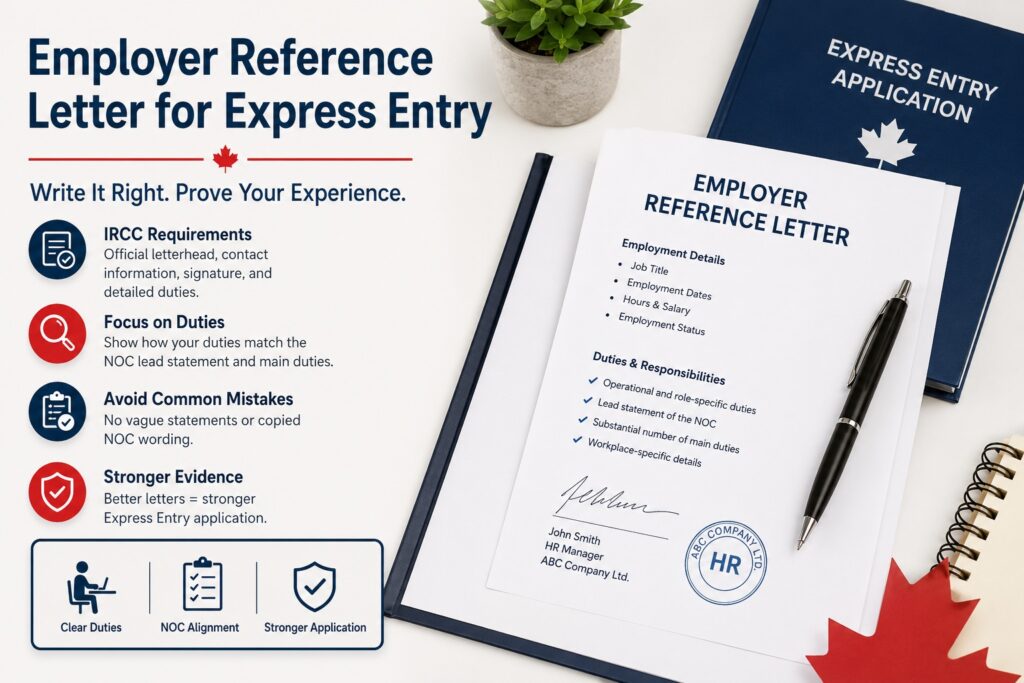
What Should an Employer Reference Letter Include?
RCC officers generally expect employer letters to clearly establish the applicant’s qualifying work experience, employment conditions, and actual duties performed.
Employer reference letters should generally:
- be printed on company letterhead,
- include employer contact information,
- contain the applicant’s name,
- identify the supervisor or HR representative,
- include dates of employment,
- list hours worked,
- confirm salary and benefits,
- and describe duties and responsibilities.
However, simply including these elements is not always enough.
Officers often assess whether the duties genuinely reflect the applicant’s real workplace responsibilities and whether the documentation appears credible and internally consistent with the overall application.
Why Copying NOC Duties Can Be Dangerous
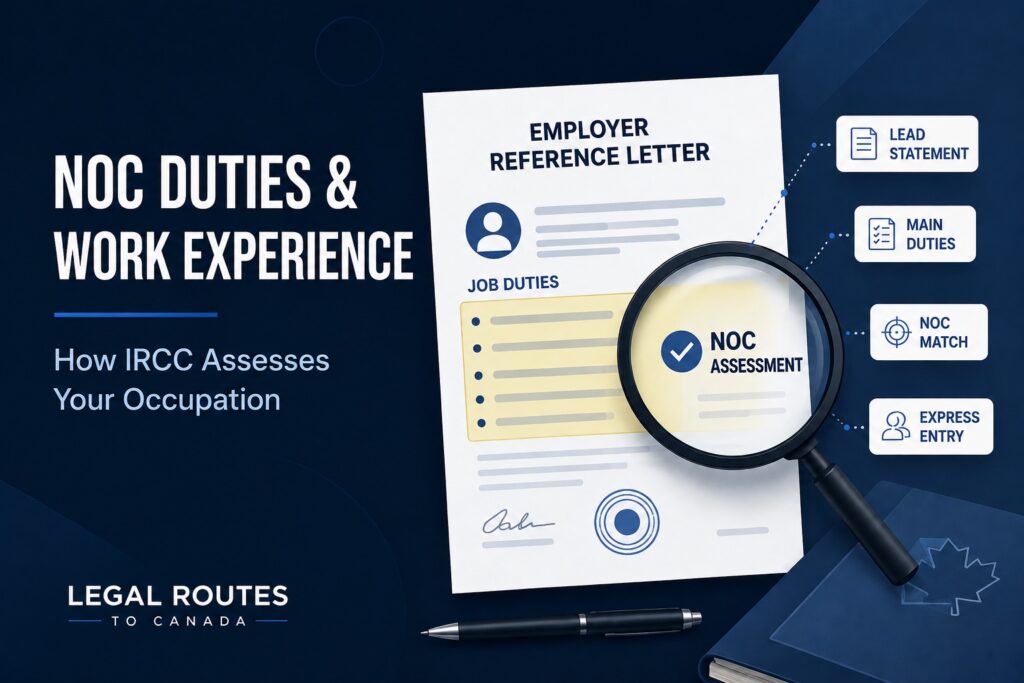
One of the most common mistakes in Express Entry applications is submitting employer letters that simply copy the National Occupational Classification (NOC) description.
Many applicants believe that copying NOC wording strengthens the application.
In practice, this can sometimes create the opposite result.
IRCC officers frequently look for:
- employer-specific details,
- actual day-to-day responsibilities,
- workplace context,
- tools and systems used,
- operational examples,
- and practical descriptions of how duties were performed.
Applications can face refusal when officers conclude that the letters merely repeat NOC language without demonstrating the real nature of the employment.
For example, a strong restaurant supervisor letter may describe:
- supervising kitchen staff during high-volume evening shifts,
- resolving customer service complaints,
- monitoring food preparation timelines,
- coordinating front-of-house and kitchen operations,
- handling inventory shortages,
- and training new employees on workplace procedures.
Similarly, a strong IT support letter may reference:
- ticketing systems,
- VPN troubleshooting,
- remote desktop tools,
- escalation procedures,
- internal systems support,
- and actual troubleshooting environments.
These practical details often make the employment appear significantly more credible than generic NOC wording alone.
Applicants should understand that:
- the NOC is a classification tool,
- not a template that should be copied word-for-word into employer letters.
Practical specificity often matters more than keyword repetition.
Completeness vs Credibility: A Critical Distinction
This is one of the most misunderstood areas of Express Entry applications.
Many applicants assume:
- if the application passes R10,
- then IRCC has accepted the work experience.
That is incorrect.
At the R10 completeness stage, officers primarily assess whether the required documents were included.
The deeper assessment happens later.
During eligibility review, officers may examine:
- whether duties genuinely match the selected NOC,
- whether the work experience is credible,
- whether the employment appears genuine,
- whether the applicant performed the lead statement and substantial number of duties,
- and whether CRS points were properly claimed.
This later stage often leads to refusals under:
- A11.2 of the Immigration and Refugee Protection Act,
- or program-specific eligibility provisions such as R87.1 for the Canadian Experience Class.
An application can therefore be:
- complete,
- accepted into processing,
- and still later refused.
Understanding A11.2 Refusals
A11.2 is one of the most important provisions in Express Entry applications.
Under section 11.2 of the Immigration and Refugee Protection Act, applicants must possess the qualifications and CRS basis upon which they received their Invitation to Apply.
Official legislation regarding section 11.2 of the Immigration and Refugee Protection Act can be reviewed here:
If IRCC later determines that:
- work experience was not properly established,
- CRS points were incorrectly claimed,
- or the applicant no longer meets the criteria that supported the ITA,
then the application may be refused.
This commonly occurs when:
- work experience is rejected,
- employer letters are weak,
- duties do not sufficiently match the NOC,
- self-employment evidence is inadequate,
- or supporting documentation is inconsistent.
Why Applications Can Pass R10 but Still Be Refused
Passing the completeness stage does not guarantee approval.
In many cases:
- the application passes the completeness stage,
- enters processing,
- and is later refused after a detailed eligibility review.
This demonstrates why completeness and eligibility are not the same thing.
R10 Rejection vs A11.2 Refusal
Understanding the difference between these two concepts is critical because many applicants incorrectly use them interchangeably.
| Issue | R10 Completeness Check | A11.2 Eligibility Assessment |
|---|---|---|
| Main Purpose | Determines whether the application is complete | Determines whether the applicant genuinely meets Express Entry requirements |
| Assessment Stage | Initial review stage | Later eligibility review |
| Focus | Missing or required documents | Credibility and validity of claimed qualifications |
| Common Concerns | Missing PCC, absent uploads, incomplete forms | Weak employer letters, unsupported CRS points, incorrect NOC |
| Outcome | Application rejected as incomplete | Application refused after eligibility review |
| Fees | Usually refunded | Generally not refunded |
| Processing | Usually stops early | Application proceeds into substantive assessment |
Applicants often assume that once the application passes R10, the work experience has already been accepted.
That is not how Express Entry processing works.
Missing Documents and Letters of Explanation (LoEs)
Many applicants face situations where a required document cannot be obtained before the submission deadline.
Common examples include:
- delayed police certificates,
- unavailable employer letters,
- missing salary records,
- employer closures,
- or delayed government processing.
In some situations, IRCC may exercise flexibility where delays occur outside the applicant’s control.
However, applicants should understand that flexibility is discretionary — not automatic.
A Letter of Explanation (LoE) does not guarantee acceptance.
When IRCC May Accept Missing Documents
Strong Letters of Explanation are usually:
- concise,
- factual,
- organized,
- document-supported,
- and focused on evidence rather than emotional arguments.
A well-prepared explanation should generally:
- explain why the document is unavailable,
- demonstrate efforts made to obtain it,
- provide supporting evidence,
- and clearly identify when the missing document is expected.
For example, where a police certificate is delayed, applicants may include:
- proof of application,
- payment receipts,
- appointment confirmations,
- government processing correspondence,
- and a timeline of efforts made.
Similarly, where an employer refuses to issue an updated reference letter, supporting evidence may include:
- pay stubs,
- employment contracts,
- tax records,
- supervisor emails,
- or payroll documentation.
The goal is to demonstrate transparency, consistency, and good-faith efforts to comply with IRCC requirements.
Self-Employment and Express Entry Work Experience
Self-employment creates additional complexity in Express Entry applications.
IRCC specifically states that:
- self-declared duties or affidavits alone are not sufficient,
- and third-party documentation is expected.
Depending on the situation, applicants may need:
- business registration records,
- tax documentation,
- invoices,
- contracts,
- payment records,
- client correspondence,
- proof of services provided,
- and evidence of business ownership.
Applicants should also understand that self-employment generally does not count toward Canadian Experience Class eligibility under section 87.1 of the Immigration and Refugee Protection Regulations.
This distinction is often misunderstood.
Common Express Entry R10 Mistakes
Many Express Entry problems are preventable.
In practice, some of the most serious refusals arise from avoidable documentation mistakes, inconsistencies, or poorly prepared employer letters.
1. Employer Letters That Copy the NOC
One of the most common mistakes is submitting duties that appear artificially copied from the NOC website.
Strong applications usually contain realistic workplace detail.
2. Missing Salary or Hours Information
Incomplete employer letters often create avoidable concerns.
3. Uploading Unclear or Poor-Quality Documents
IRCC must be able to clearly review documents. Blurred scans, missing pages, incomplete uploads, or illegible documents may result in delays or an application being rejected as incomplete.
Applicants should also follow any document-specific upload instructions. For example, police certificates must be uploaded as colour scans of the original certificate(s).
4. Waiting Too Long for Police Certificates
Applicants should begin obtaining police certificates early whenever possible.
5. Assuming Completeness Means Approval
Passing the R10 stage does not mean:
- work experience has been accepted,
- CRS points are secure,
- or eligibility has been finalized.
6. Inconsistent Work History Information
Dates, wages, hours, positions, and duties should remain consistent across:
- reference letters,
- resumes,
- tax documents,
- work permits,
- and Express Entry profile declarations.
Practical Strategy for Stronger Express Entry Applications
Strong Express Entry applications are usually:
- organized,
- internally consistent,
- document-supported,
- and factually specific.
Applicants should focus on:
- accurate NOC selection,
- understanding how IRCC assesses NOC duties,
- employer-specific duties,
- supporting payroll evidence,
- proper timelines,
- clear explanations,
- and consistency across all documents.
A well-prepared application is not simply about uploading documents.
It is about demonstrating that:
- the claimed experience genuinely existed,
- the documentation is credible,
- and the applicant genuinely meets the legal requirements of the program.
Frequently Asked Questions (FAQs)
What is the R10 completeness check in Express Entry?
The R10 completeness check is IRCC’s initial review of an Express Entry application to determine whether all required documents and mandatory information have been provided.
Can my application be rejected before processing?
Yes. If mandatory documents are missing or the application is incomplete, IRCC may reject the application during the completeness stage.
Does passing R10 mean my application is approved?
No. Passing R10 only means the application was considered complete enough to enter processing. Eligibility and credibility assessments happen later.
What happens if my employer letter copies the NOC?
This can create serious problems. IRCC may conclude that the letter does not genuinely describe your actual duties and may refuse the work experience claim.
What is the difference between R10 and A11.2?
R10 relates to document completeness.
A11.2 relates to whether the applicant actually possessed the qualifications and CRS basis upon which the Invitation to Apply was issued.
Can I submit a Letter of Explanation for missing documents?
Yes. In some situations, applicants may provide:
- proof that documents were requested,
- supporting evidence,
- and a detailed explanation.
However, acceptance is discretionary and not guaranteed.
Can self-employment count toward Canadian Experience Class eligibility?
Generally, no. Self-employment does not normally count toward Canadian Experience Class work experience requirements.
Final Thoughts
The Express Entry R10 completeness check is one of the most important early stages of a permanent residence application.
However, applicants should understand that completeness alone does not guarantee approval.
Many applicants submit technically complete applications that later face refusal because:
- employer letters lack credibility,
- duties do not sufficiently match the selected NOC,
- documentation is inconsistent,
- or claimed CRS points cannot be properly supported.
In Express Entry applications, officers are not only assessing whether documents exist.
They are assessing whether the overall evidence genuinely supports the claims made in the application.
This is particularly important for:
- Canadian work experience claims,
- employer reference letters,
- self-employment evidence,
- NOC classification issues,
- and CRS-related points.
Well-prepared applications are usually:
- organized,
- internally consistent,
- factually detailed,
- employer-specific,
- and supported by credible evidence.
Applicants should avoid treating Express Entry as a simple document upload exercise.
The strongest applications are typically those that clearly demonstrate:
- how the applicant performed their duties,
- how the work experience genuinely aligns with the selected occupation,
- and why the supporting evidence is reliable and consistent.
For many applicants, careful preparation at the beginning can help prevent:
- unnecessary delays,
- procedural fairness concerns,
- A11.2 refusals,
- or avoidable work experience disputes later in processing.
As Express Entry applications become increasingly scrutinized, detailed and credible documentation is becoming more important than ever.
Disclaimer: This article is provided for general informational purposes only and does not constitute legal advice or create a consultant-client relationship. Immigration applications are assessed based on individual facts, evidence, and applicable law.