Choosing the correct National Occupational Classification (NOC) is one of the most important decisions in many Canadian immigration applications. Whether applying through Express Entry, a Provincial Nominee Program, or another economic immigration pathway, applicants are often required to demonstrate that their work experience matches the occupation being claimed.
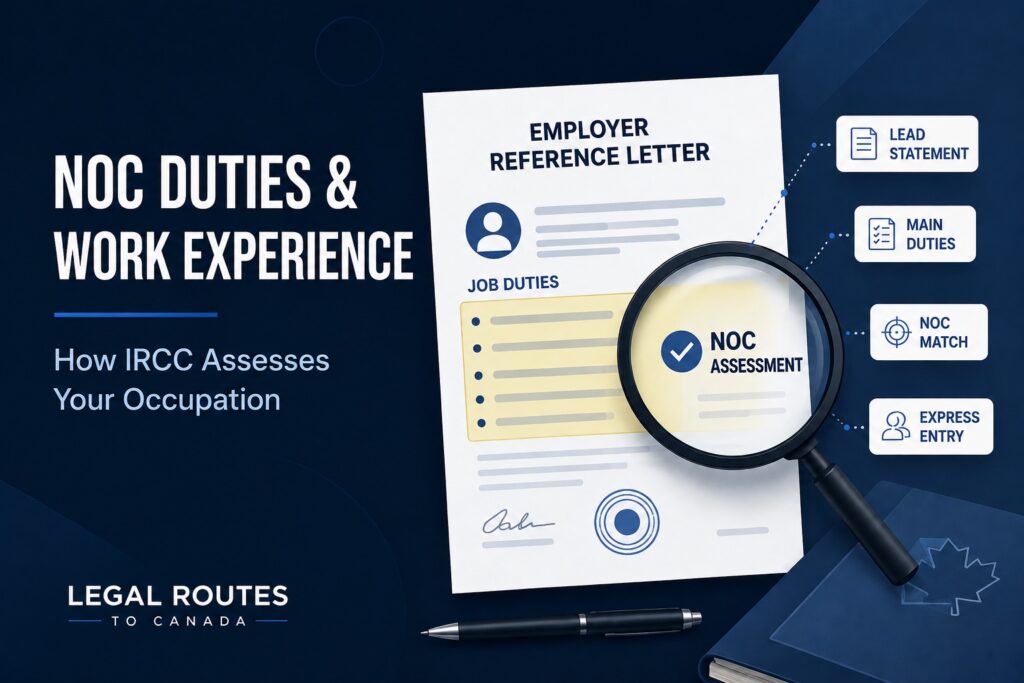
Many applicants focus primarily on their job title when selecting a NOC. However, IRCC officers do not assess occupations based on job titles alone. Instead, they examine the lead statement, main duties, supporting documentation, and overall nature of the work performed to determine whether the claimed occupation has been established.
This distinction is extremely important.
An applicant may genuinely have worked for an employer, received salary payments, and possess legitimate employment records. However, if the evidence does not demonstrate that the work performed aligns with the claimed NOC, the work experience may be excluded from the assessment. In some cases, this can result in a loss of eligibility, a reduction in Comprehensive Ranking System (CRS) points, or the refusal of an immigration application.
Understanding how NOC duties are assessed can help applicants select the correct occupation, prepare stronger supporting documentation, and avoid common mistakes that may lead to refusal.
How Does IRCC Determine Whether Work Experience Matches a NOC?
IRCC generally assesses whether an applicant:
- Performed the actions described in the NOC lead statement
- Performed a substantial number of the main duties associated with the occupation
- Can demonstrate the occupation through credible supporting documentation
- Submitted employment records that support the claimed work experience
Job titles alone do not determine the correct NOC code. Officers assess the actual work performed and whether it aligns with the occupation being claimed.
What Is a NOC and Why Does It Matter?
The National Occupational Classification (NOC) is Canada’s system for categorizing occupations based on the type of work performed and the duties associated with each occupation.
Every NOC occupation contains several important components:
- A lead statement describing the occupation
- Main duties associated with the occupation
- Illustrative job titles
- Employment requirements
- TEER (Training, Education, Experience, and Responsibilities) classification information
Immigration programs frequently rely on the NOC system to determine whether an applicant’s work experience qualifies for a particular immigration pathway.
NOCs play an important role in:
- Express Entry applications
- Canadian Experience Class (CEC) applications
- Federal Skilled Worker (FSW) applications
- Federal Skilled Trades (FST) applications
- Provincial Nominee Programs (PNP)
- Work permit applications
- Labour Market Impact Assessment (LMIA) applications
Selecting the wrong NOC code can have significant consequences. Even where an applicant genuinely performed the work and possesses supporting documentation, IRCC may conclude that the occupation claimed does not accurately reflect the work performed.
How to Choose the Correct NOC
One of the most common mistakes applicants make is selecting a NOC based primarily on their job title.
This approach can create serious problems because employers often use internal job titles that differ significantly from the NOC system.
For example, a person working as an “Operations Coordinator,” “Office Coordinator,” or “Assistant Manager” may potentially fit multiple occupations depending on their actual responsibilities.
Choosing the correct NOC requires a more detailed assessment.
Applicants should generally:
- Search potential occupations using their job title.
- Review the lead statement carefully.
- Compare their actual day-to-day duties to the NOC duties.
- Review industry context and employment requirements.
- Determine which occupation best reflects the work actually performed.
The goal is not to find a perfect match.
The goal is to identify the occupation that most accurately describes the work performed throughout the qualifying period.
Step 1: Start With Your Job Title
A job title can be a useful starting point when researching potential NOCs.
The Government of Canada NOC database allows users to search occupations using job titles and keywords. This can help applicants identify several occupations that may potentially apply to their role.
However, finding a NOC through a title search does not automatically mean that the occupation is correct.
For example:
- An “Office Coordinator” may fit several administrative occupations.
- An “IT Coordinator” may fit different technical support or information systems occupations.
- An “Assistant Manager” may fit entirely different NOCs depending on the industry and responsibilities involved.
A title search should therefore be viewed as a way to create a shortlist of possible occupations rather than a final determination.
Step 2: Review the Lead Statement
The lead statement is often the most overlooked part of the NOC assessment.
Many applicants immediately compare their duties to the list of main duties without carefully reviewing the occupation description itself.
This can be a mistake.
The lead statement describes the overall nature of the occupation and often provides the clearest indication of whether a NOC is appropriate.
When reviewing a NOC, ask yourself:
Does this description sound like the occupation I actually performed?
If the answer is no, the NOC may not be appropriate even if some duties appear similar.
The lead statement often reveals whether an applicant is attempting to fit their work experience into an occupation that does not accurately reflect their role.
For this reason, applicants should always review the lead statement before analyzing individual duties.
Step 3: Compare Your Actual Duties
Once a potential NOC has been identified, applicants should compare their actual duties against the main duties listed within the occupation.
The focus should be on the work that was genuinely performed.
Applicants should avoid asking:
“Which NOC sounds best?”
Instead, the question should be:
“Which NOC best describes what I actually did every day?”
When conducting this assessment, applicants should consider:
- Day-to-day responsibilities
- Operational tasks performed
- Decision-making authority
- Tools and systems used
- Industry environment
- Workplace responsibilities
The assessment should focus on the overall nature of the occupation rather than isolated tasks.
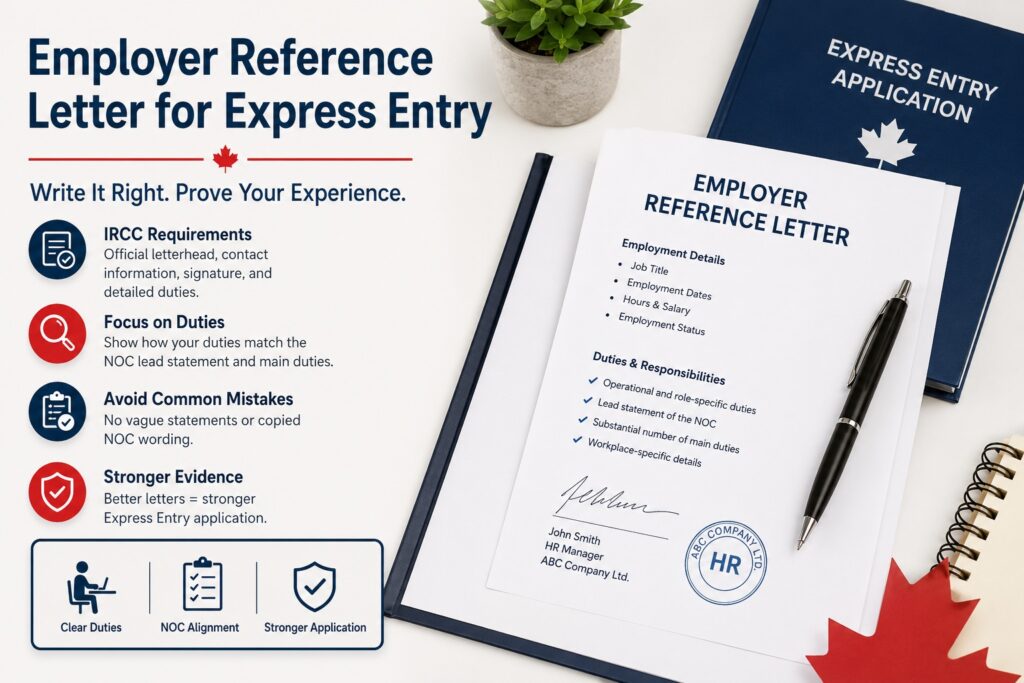
Importantly, applicants should avoid copying NOC duties directly into employer reference letters. Officers often look for workplace-specific descriptions that explain how the work was actually performed.
Strong employer reference letters describe real responsibilities, workplace functions, and operational duties rather than simply repeating wording taken from the NOC database.
How Many Duties Must Match a NOC?
There is no fixed percentage of duties that must match a NOC code.
IRCC generally assesses whether the applicant:
- Performed the actions described in the lead statement, and
- Performed a substantial number of the main duties for the occupation
The focus is on the overall nature of the work performed, not a perfect word-for-word match with every duty listed in the NOC.
When assessing a potential NOC, applicants should focus on whether the occupation as a whole accurately reflects their work experience. This includes reviewing the lead statement, comparing actual day-to-day duties, and ensuring that supporting documents clearly demonstrate the occupation being claimed.
Job Titles vs Duties: Which Matters More?
One of the most common misconceptions in Canadian immigration is that a job title determines the correct NOC.
In reality, IRCC officers are primarily concerned with the work that was actually performed rather than the title assigned by the employer.
Employers frequently use internal job titles that do not perfectly correspond with occupations listed in the National Occupational Classification system. A person may be called an Operations Coordinator, Office Administrator, Assistant Manager, Project Coordinator, or Technician, yet those titles alone provide little information about the actual nature of the work performed.
For this reason, officers assess the substance of the employment rather than the label attached to it.
When reviewing work experience, IRCC generally considers:
- The NOC lead statement
- The applicant’s day-to-day responsibilities
- The employer reference letter
- Supporting documentation
- The overall nature of the occupation
An applicant may hold a title that appears to match a NOC, but if the duties suggest a different occupation, the officer may conclude that the wrong NOC has been selected.
Conversely, an applicant may have a unique or unusual job title while still qualifying under a particular NOC if the actual duties performed align with that occupation.
The question is therefore not:
“What was my job title?”
The more important question is:
“What work did I actually perform?”
What If No NOC Matches Perfectly?
Applicants are often surprised to discover that no NOC describes their job with complete accuracy.
This is normal.
The National Occupational Classification is intended to classify occupations across thousands of employers and industries throughout Canada. It is not designed to capture every workplace, every business model, or every variation of a particular role.
As a result, applicants should not expect every duty listed in their employment letter to appear in the NOC description.
Similarly, they should not expect every duty listed in the NOC to appear in their employment letter.
The objective is to identify the occupation that most accurately reflects the overall nature of the work performed.
A reasonable NOC assessment typically involves:
- Reviewing several possible occupations
- Comparing lead statements
- Comparing the main duties
- Considering industry context
- Determining which occupation best reflects the actual role
Applicants should avoid searching for a perfect match and instead focus on identifying the most appropriate occupational classification.
Industry Context and Employment Requirements Matter
Many applicants focus exclusively on job duties while overlooking other parts of the NOC description.
However, the surrounding context can also be important.
When reviewing a potential NOC, applicants should consider:
- The industry in which the work was performed
- The type of employer
- Typical responsibilities associated with the occupation
- Employment requirements listed within the NOC
These factors can help determine whether a particular occupation is truly appropriate.
For example, some occupations require licensing, certification, apprenticeship training, or professional qualifications before certain duties can legally be performed.
In skilled trades occupations, this distinction can become particularly important.
An applicant may work in a construction environment and perform tasks that support licensed tradespeople. However, supporting a trade is not necessarily the same as performing the trade itself.
In those situations, the correct NOC may be a helper or support occupation rather than the skilled trade occupation itself.
Similarly, an applicant may work in an accounting office, engineering firm, healthcare setting, or information technology environment without actually performing the duties associated with the regulated profession.
The focus should always remain on the occupation being performed rather than the workplace where the employment occurred.
Example: How a Baker NOC Is Assessed
Consider an applicant employed as a Baker.
Their duties may include:
- Preparing doughs, batters, and baked goods
- Operating commercial baking equipment
- Monitoring product quality
- Decorating cakes and pastries
- Maintaining food safety standards
These duties align with the overall nature of a baker’s occupation because they reflect the commercial preparation and production of baked goods.
Now compare that to a letter that simply states:
Made pizzas and sandwiches, assisted with catering orders, served customers, and occasionally helped with baking projects.
Although baking activities are mentioned, the overall nature of the work may suggest a different occupation.
This example illustrates why officers assess the occupation as a whole rather than focusing on isolated keywords or individual duties.
Example: Why an Electrician Helper May Not Qualify as an Electrician
Applicants sometimes assume that working alongside a skilled tradesperson means they can claim the same occupation for immigration purposes. However, IRCC assesses the duties actually performed rather than the trade environment in which the work occurred.
For example, an individual may work on a construction site assisting electricians by pulling cables, preparing work areas, moving materials, and supporting installations. Although the work takes place within the electrical trade, those duties may not reflect the occupation of an electrician.
An electrician is generally responsible for installing, maintaining, testing, troubleshooting, and repairing electrical systems. A helper, by contrast, typically performs support functions that assist qualified tradespeople.
This distinction can be important when selecting a NOC. Two workers may be employed on the same project and work in the same environment but fall under different NOC codes because their responsibilities differ significantly.
Common NOC Selection Mistakes
Several recurring mistakes appear in refused applications.
Choosing a NOC Based Solely on Job Title
Applicants sometimes select a NOC because the title appears similar to their position.
This approach can result in a mismatch when the actual duties correspond to a different occupation.
Ignoring the Lead Statement
Many applicants review only the list of duties and overlook the occupation description.
The lead statement often provides the clearest indication of whether a NOC is appropriate.
Focusing on One or Two Duties
Most occupations share overlapping responsibilities.
A correct NOC assessment requires consideration of the overall role rather than isolated duties.
Copying NOC Duties Into Employer Letters
This is one of the most common issues seen in Express Entry refusals.
Employer letters should describe actual workplace responsibilities rather than simply repeating language taken from the NOC database.
When a letter mirrors the NOC wording without providing meaningful workplace context, officers may question whether the duties accurately describe the work performed.
Real Examples of Weak vs Strong Employer Letters
Many NOC-related refusals do not occur because the applicant selected the wrong occupation. Instead, the refusal occurs because the evidence submitted does not adequately demonstrate that the claimed occupation was actually performed.
Employer reference letters are often the most important documents used to assess work experience. A strong letter helps an officer understand the applicant’s day-to-day responsibilities and how the work aligns with the claimed NOC. A weak letter may leave the officer unable to determine what occupation was actually performed.
The following examples illustrate common differences between weak and strong employment documentation.
Note: The examples below have been anonymized for educational purposes. Names, employers, and identifying information have been removed.
Example 1: Baker Occupation
Weak Baker Letter

This letter confirms employment but provides only limited information regarding the applicant’s duties. While baking-related activities may be mentioned, the officer may struggle to determine whether the applicant actually performed the occupation of a baker.
The letter focuses on broad tasks without clearly describing the production of baked goods, commercial baking processes, quality control responsibilities, or other duties typically associated with the occupation.
Strong Baker Letter
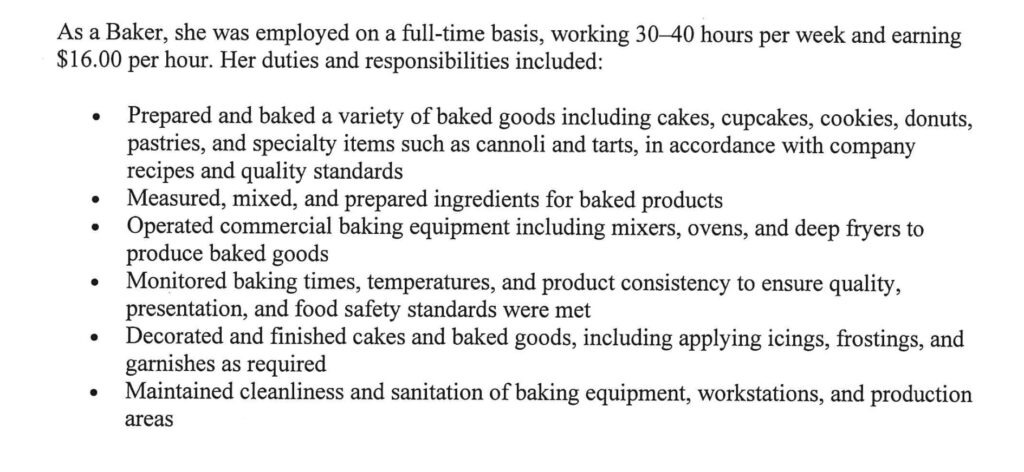
This letter provides significantly more detail regarding the applicant’s actual responsibilities.
The duties describe the preparation of doughs and batters, operation of baking equipment, production of baked goods, quality control procedures, and food safety practices. These workplace-specific details make it easier for an officer to compare the duties against the claimed NOC and assess whether the occupation has been established.
The goal is not to copy the NOC description. The goal is to explain how the work was actually performed.
Example 2: Food Service Supervisor Occupation
Weak Food Service Supervisor Letter
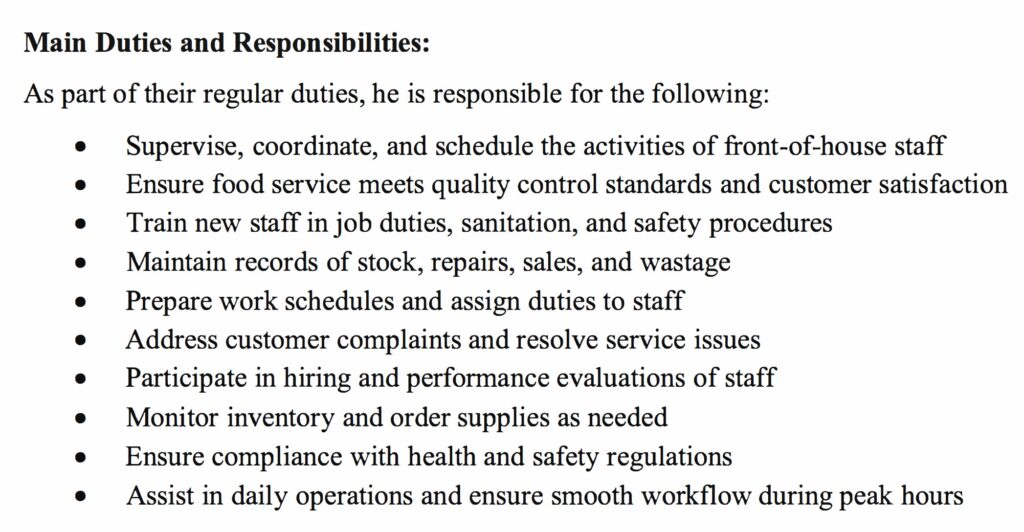
This letter contains duties that closely resemble standard NOC wording. While some duties may technically correspond with the occupation, the description provides little insight into the applicant’s actual workplace responsibilities.
An officer reviewing this type of letter may ask:
What did this employee actually do on a daily basis?
When the letter provides limited operational detail, assessing the occupation becomes more difficult.
Strong Food Service Supervisor Letter
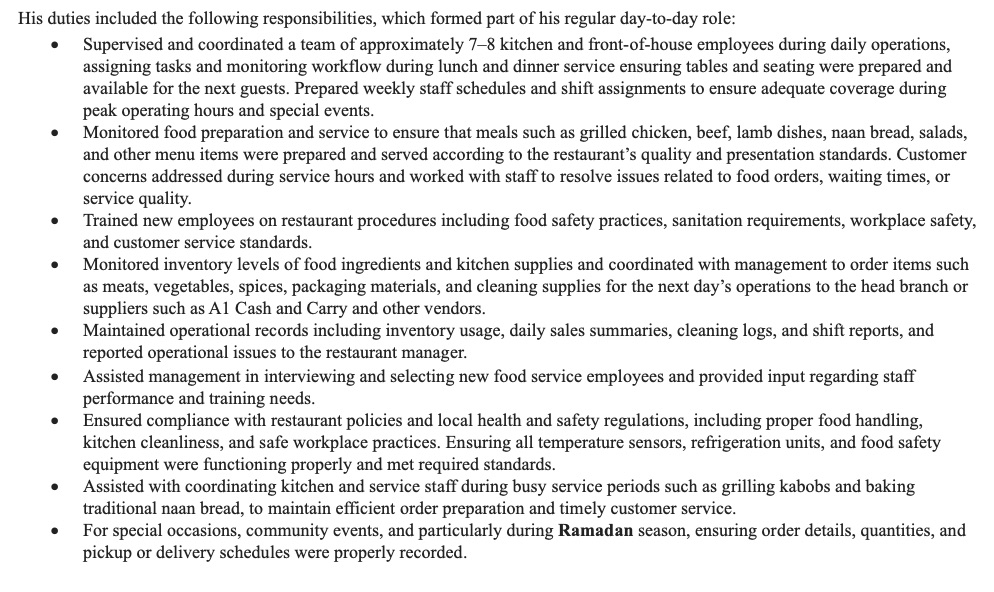
This letter provides workplace-specific responsibilities rather than generic statements.
The duties describe supervising staff, coordinating shifts, managing inventory, handling customer concerns, assisting with recruitment, and overseeing day-to-day restaurant operations. These details provide context and help demonstrate how the supervisory role functioned in practice.
As a result, the officer is better positioned to assess whether the claimed occupation aligns with the NOC.
Weak vs Strong Employer Letters
| Weak Employer Letter | Strong Employer Letter |
|---|---|
| Generic duties | Workplace-specific duties |
| Relies heavily on job title | Explains actual responsibilities |
| Limited operational detail | Describes day-to-day work |
| Closely copies NOC wording | Uses real workplace language |
| Makes occupation difficult to assess | Helps demonstrate the claimed occupation |
| Provides minimal context | Clearly explains how the role was performed |
The strongest employer reference letters are usually those that accurately describe the applicant’s real responsibilities rather than attempting to mirror the NOC description. Officers are trying to understand the occupation actually performed, not whether the employer can reproduce wording from the NOC database.
Real Examples of Officer Concerns About NOC Duties
One of the most common reasons for work experience refusals is not the absence of employment, but the inability to determine whether the duties performed match the claimed occupation.
IRCC officers must be satisfied that an applicant performed the occupation being claimed. When employer reference letters contain vague descriptions, copied NOC wording, or insufficient operational detail, officers may conclude that the work experience has not been adequately established.
The following examples illustrate common concerns raised during work experience assessments.
Example 1: Duties Too Vague to Assess

In this example, the officer noted that the duties provided were too vague to be properly assessed against the claimed NOC.
When a letter contains only broad or generic descriptions, an officer may be unable to determine:
- What work was actually performed
- Whether the lead statement is met
- Whether a substantial number of the main duties were performed
Simply confirming that employment occurred is often not enough. The duties must allow the officer to understand the nature of the occupation being performed.
Example 2: Duties Mirror the NOC Description

In this example, the officer expressed concern that the employer reference letters closely mirrored the NOC description rather than describing the applicant’s actual workplace responsibilities.
This is a common issue in Express Entry applications.
While applicants often review NOC descriptions when preparing employment documentation, employer letters should explain the work actually performed rather than reproduce wording from the NOC database.
Officers are attempting to assess the occupation itself. Generic descriptions copied from the NOC may provide little evidence of how the role functioned in practice.
Important: A refusal based on NOC duties does not necessarily mean IRCC believes the applicant did not work for the employer. In many cases, the issue is whether the evidence submitted sufficiently demonstrates that the work performed matches the occupation being claimed.
What Happens When IRCC Disagrees With Your NOC?
When an officer concludes that the duties described in the evidence do not support the claimed occupation, the consequences can be significant.
Depending on the circumstances, the officer may determine that:
- The lead statement has not been established
- A substantial number of the main duties have not been demonstrated
- The claimed work experience cannot be counted
- The applicant no longer meets program eligibility requirements
- The applicant no longer possesses the CRS score that supported the Invitation to Apply (ITA)
In Express Entry applications, work experience is often tied directly to both eligibility and CRS points. If an officer determines that the claimed occupation has not been established, the work experience may be excluded from the assessment. This can affect program eligibility, reduce CRS points, and in some cases result in an A11.2 reassessment of the qualifications that supported the Invitation to Apply.
Importantly, officers are not required to accept a claimed NOC simply because an employer has assigned a particular job title. The officer’s role is to assess the evidence and determine whether the occupation has been established based on the work actually performed.
Will IRCC Always Issue a Procedural Fairness Letter for NOC Concerns?
Not necessarily.
Many applicants assume that IRCC must issue a Procedural Fairness Letter (PFL) before refusing an application based on work experience concerns. However, this is not always the case.
In many situations, officers assess the employer reference letters and supporting documentation submitted by the applicant and make a decision based on that evidence alone. If the officer concludes that the duties described do not establish the claimed occupation, a refusal may occur without a Procedural Fairness Letter.
Generally speaking, concerns relating to the sufficiency of evidence are treated differently from concerns relating to the credibility, authenticity, or genuineness of the evidence.
For example, a Procedural Fairness Letter may be more likely where an officer:
- Relies on information that the applicant has not previously seen;
- Discovers contradictory evidence;
- Questions the authenticity of documents;
- Raises credibility concerns regarding the claimed work experience.
By contrast, a Procedural Fairness Letter may not be required where an officer simply concludes that:
- The duties are too vague;
- The lead statement has not been established;
- A substantial number of the main duties have not been demonstrated; or
- The evidence submitted is insufficient to support the claimed NOC.
Whether a Procedural Fairness Letter is required depends on the specific facts of the case. Applicants should therefore not assume that they will receive an opportunity to correct deficiencies after submission. The strongest approach is to ensure that the NOC selection and supporting documentation are properly prepared from the outset.
What Remedies Are Available After a NOC-Based Refusal?
A refusal based on NOC duties or work experience does not necessarily mean that all immigration options have been exhausted.
Depending on the circumstances, applicants may have several potential remedies available.
1. Submitting a New Application
In many cases, the most practical solution is to submit a new application with stronger supporting evidence.
Before reapplying, applicants should carefully review the refusal reasons and determine whether:
- The wrong NOC was selected;
- The duties were insufficiently described;
- The employer reference letter lacked detail;
- Additional supporting documentation is available; or
- A different occupation more accurately reflects the work performed.
Many NOC-related refusals can be addressed by reassessing the occupation and providing stronger evidence that clearly demonstrates the work experience being claimed.
2. Requesting Reconsideration
In some situations, applicants may request reconsideration of a refusal decision.
Reconsideration requests are commonly made where an applicant believes the officer may have:
- Overlooked material evidence;
- Misunderstood the documentation submitted;
- Made a factual error; or
- Failed to consider information already contained in the application.
However, it is important to understand that officers are generally not obligated to reopen a finalized application. Reconsideration requests are discretionary, and there is no automatic right to have a refused application reconsidered.
While successful reconsideration requests do occur, applicants should not assume that a refusal will automatically be reopened for review.
3. Judicial Review Before the Federal Court
In certain circumstances, applicants may challenge a refusal through an application for judicial review before the Federal Court.
It is important to understand that judicial review is not a new assessment of the immigration application. The Court does not determine whether the applicant qualifies for permanent residence. Instead, the Court reviews whether the officer’s decision was reasonable and procedurally fair.
Example: Judicial Review Dismissed
In Lal v. Canada, the applicant claimed work experience as an electrician. However, the duties described in the employment letter primarily involved assisting electricians rather than independently performing the occupation. The officer concluded that the duties did not correspond with the lead statement and main duties of the claimed NOC, and the Federal Court upheld the refusal.
This case illustrates that simply working within a particular industry or trade environment does not necessarily establish the occupation being claimed. The Court accepted that the officer was entitled to assess the actual duties performed and determine whether they matched the selected NOC.
Example: Judicial Review Allowed
In Nauman v. Canada, the Federal Court reviewed a refusal involving concerns about the applicant’s work experience and the assessment of the supporting evidence. The Court ultimately found that the matter should be returned for redetermination. The case illustrates that judicial review may be available where concerns arise regarding the manner in which the officer assessed the evidence or reached the refusal decision.
The outcome of every case depends on its specific facts. Judicial review is therefore not a guaranteed remedy, but it may be appropriate in situations where there are concerns regarding the reasonableness or fairness of the decision-making process.
Key Takeaway
A NOC-based refusal does not automatically mean the end of an immigration journey. Depending on the circumstances, applicants may be able to:
- Reapply with stronger evidence;
- Request reconsideration; or
- Pursue judicial review before the Federal Court.
The appropriate remedy will depend on the refusal reasons, the available evidence, and the overall circumstances of the case.
Frequently Asked Questions About NOC Duties and Work Experience
Does my job title need to match the NOC exactly?
No.
IRCC does not assess work experience based solely on job titles. Officers primarily assess the lead statement, main duties, and overall nature of the work performed. A job title may be helpful, but it does not determine the correct NOC on its own.
How many duties must match a NOC?
There is no fixed percentage.
IRCC generally assesses whether the applicant performed the actions described in the lead statement and a substantial number of the main duties associated with the occupation. The focus is on the overall nature of the work rather than a perfect word-for-word match.
Can two different job titles fall under the same NOC?
Yes.
Employers often use different titles for similar roles. Two employees may have different job titles but perform substantially similar duties that fall under the same NOC.
Can one job title fit multiple NOCs?
Yes.
A title such as Coordinator, Supervisor, Manager, or Technician may potentially correspond to multiple NOCs depending on the actual responsibilities performed.
This is why applicants should review the lead statement and duties rather than relying on the title alone.
What if my employer refuses to provide detailed duties?
Applicants should gather as much supporting evidence as possible, including:
- Employment contracts
- Pay records
- Tax documents
- Performance reviews
- Organizational charts
- Job descriptions
- Internal employment records
However, a properly drafted employer reference letter remains one of the most important forms of work experience evidence.
Applicants should also ensure that all employment documentation is complete and consistent before submission, as deficiencies identified during the R10 completeness check may create additional challenges later in the application process.
Can IRCC refuse an application because of a NOC mismatch?
Yes.
If an officer concludes that the duties described in the evidence do not support the claimed occupation, the work experience may be excluded from the assessment. Depending on the circumstances, this may affect eligibility, CRS points, or the overall outcome of the application.
Final Thoughts
Selecting the correct NOC involves much more than finding a job title that appears similar to your position.
IRCC officers assess the occupation itself by reviewing the lead statement, main duties, supporting documentation, and overall nature of the work performed. A strong application therefore requires both an appropriate NOC selection and evidence that clearly demonstrates the occupation being claimed.
Many NOC-related refusals arise not because the applicant lacked work experience, but because the evidence submitted did not sufficiently establish the claimed occupation.
Understanding how officers assess NOC duties can help applicants make informed decisions, prepare stronger documentation, and reduce the risk of avoidable refusals.
Need Assistance With Your Express Entry Application?
If you are unsure whether your work experience supports a particular NOC, have received a refusal related to work experience, or require assistance preparing supporting documentation, professional guidance may help identify potential concerns before an application is submitted.
Book a consultation with Blue Iris Immigration Services Inc. to discuss your Express Entry application strategy and work experience documentation.
Disclaimer: This article is provided for general information purposes only and does not constitute legal advice. Immigration applications are assessed based on their individual facts, evidence, and applicable legislation. Applicants should seek professional advice regarding their specific circumstances before making immigration decisions