Receiving an Invitation to Apply (ITA) under Express Entry does not guarantee permanent residence approval. One of the most heavily assessed parts of an application is the employer reference letter used to prove skilled work experience.
Many applicants assume that proving they worked for a company is enough. In reality, IRCC assesses whether the submitted evidence demonstrates that the applicant performed the duties of the claimed National Occupational Classification (NOC).
This distinction is critical.
An applicant may genuinely have worked for an employer, received salary payments, and hold legitimate employment records — yet still face refusal if the employer reference letter does not sufficiently establish the claimed skilled occupation.
For applicants relying on Canadian or foreign skilled work experience under Express Entry, understanding how employer reference letters are assessed is essential.
What Must an Employer Reference Letter Include for Express Entry?
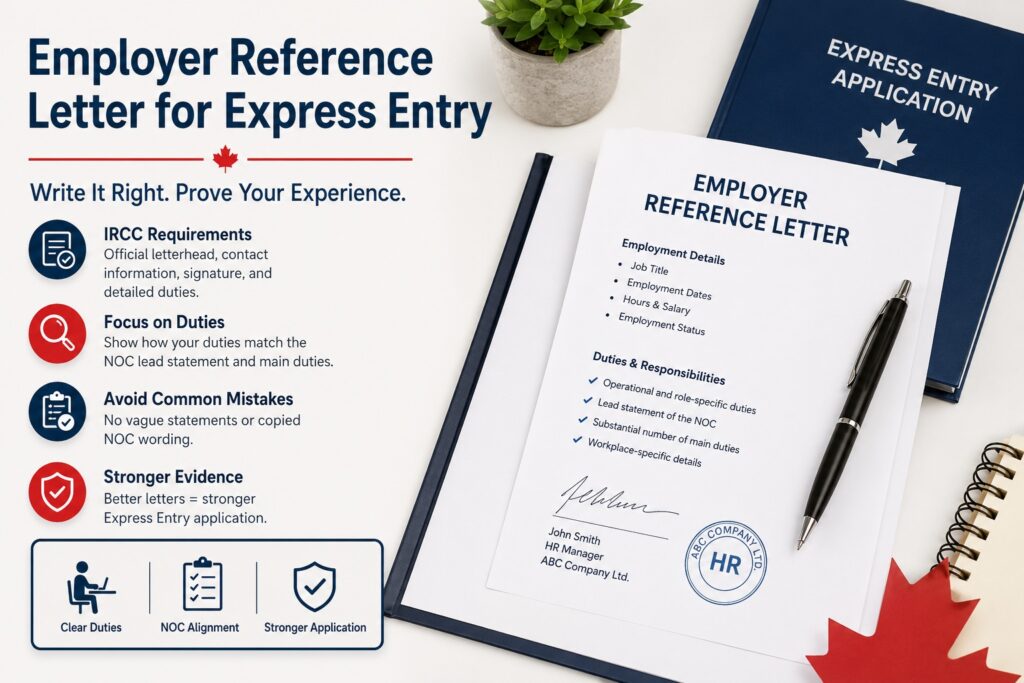
An employer reference letter for Express Entry should generally include:
• Company letterhead
• Employer contact information (address, phone number, and email)
• Employee’s name
• Job title and all positions held
• Employment dates
• Hours worked per week
• Salary and benefits
• Supervisor or authorized representative’s name, title, and signature
• Detailed job duties and responsibilities
IRCC uses employer reference letters to assess whether an applicant’s work experience aligns with the claimed National Occupational Classification (NOC). Missing information, vague duties, or insufficient detail may create concerns regarding the claimed work experience.
Why Employer Reference Letters Matter in Express Entry
Employer reference letters are not simply employment confirmation documents.
Under Express Entry, they are used to assess:
- Whether the applicant performed the lead statement of the claimed NOC.
- Whether they performed a substantial number of the main duties.
- Whether the work qualifies as skilled work.
- Whether the experience supports the CRS points claimed.
- Whether the applicant meets program eligibility requirements.
This is particularly important for:
- Canadian Experience Class (CEC)
- Federal Skilled Worker Program (FSW)
- Category-based Express Entry draws
- Foreign work experience claims
- Occupations with overlapping NOC duties
As discussed in our Express Entry R10 Completeness Check article, IRCC first verifies whether required documents were submitted. However, the actual quality, sufficiency, and credibility of employer letters are typically assessed later during processing.
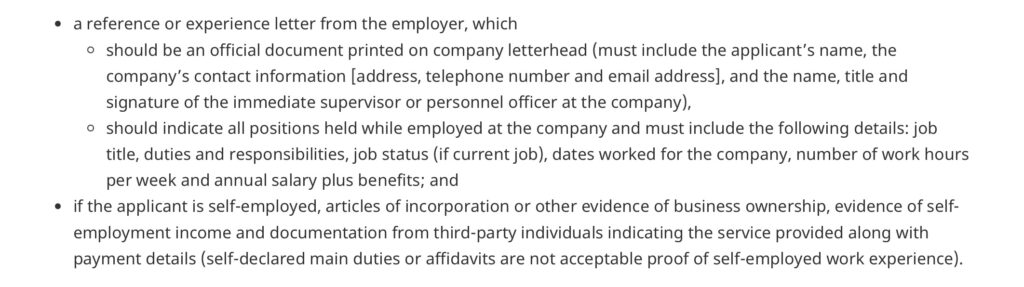
IRCC’s completeness check instructions specifically identify employer reference letters as mandatory evidence for most Express Entry work experience claims and outline the information these letters should contain.
Similarly, during an A11.2 assessment, officers may reassess whether an applicant truly qualified for the CRS points claimed at the time of invitation.
Employer reference letters often become central to both assessments.
What IRCC Requires in an Employer Reference Letter
IRCC generally expects employer reference letters to include:
- Company letterhead
- Company contact information
- Applicant’s name
- Supervisor or HR representative’s name and signature
- Job title
- Employment dates
- Hours worked
- Salary and benefits
- Employment status
- Detailed duties and responsibilities
For many applicants, the duties section becomes the most important — and most problematic — part of the letter.
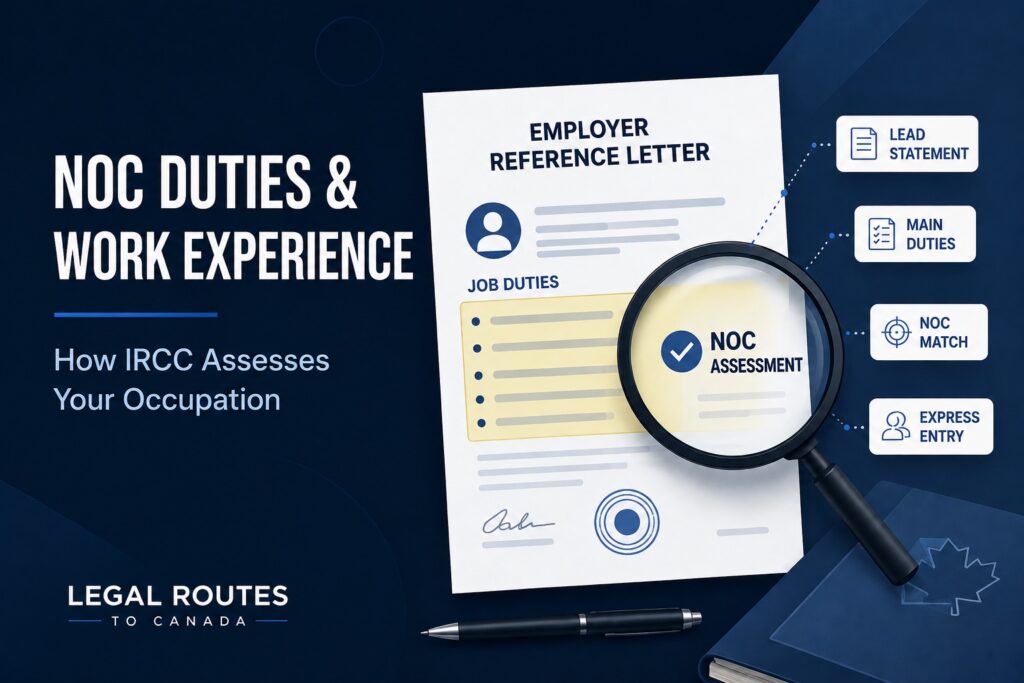
This is because officers are not only reviewing whether employment existed. They are assessing whether the actual work performed corresponds to the claimed NOC.
Understanding how IRCC assesses NOC duties can help applicants prepare stronger employer reference letters and avoid common refusal concerns.
Genuine Employment vs Sufficient Immigration Evidence
One of the most misunderstood issues in Express Entry applications is the difference between:
- Genuine employment
- Sufficient proof of skilled work experience
These are not always the same thing.
An employer letter may confirm that someone worked for a company full-time for two years. However, if the duties are vague, generic, incomplete, or inconsistent with the claimed NOC, an officer may still conclude that the applicant has not established qualifying skilled work experience.
This issue is common where:
- Job titles vary significantly.
- Duties overlap across multiple occupations.
- Operational roles differ between workplaces.
- Employer letters contain minimal detail.
Common Mistakes That Cause Refusals
Many refusal concerns arise because employer letters are drafted too generally.
Common examples include:
- Vague descriptions such as “handled customer service duties.”
- Generic HR wording.
- Copied NOC descriptions.
- Short bullet lists without operational context.
- Duties that fail to demonstrate the lead statement of the occupation.
In some cases, officers may conclude that the applicant has not shown they performed a substantial number of the main duties associated with the claimed NOC.
This issue often appears in applications involving:
- Food service supervision.
- Administrative positions.
- IT support roles.
- Technical support occupations.
- Management occupations.
- Self-employment claims.
Weak Employer Letters vs Strong Employer Letters
| Weak Employer Letter | Strong Employer Letter |
|---|---|
| Generic duties | Detailed operational duties |
| Missing hours or salary | Includes all required employment details |
| Duties copied from the NOC | Duties reflect actual workplace responsibilities |
| No context about work performed | Explains day-to-day activities |
| Relies heavily on job title | Demonstrates how the role was actually performed |
| May create eligibility concerns | Helps establish qualifying work experience |
| Minimal detail | Includes workplace-specific operational detail |
The Problem With Copying NOC Duties Directly
Many applicants search online for NOC descriptions and then reproduce those duties almost word-for-word in employer letters.
Although there is nothing inherently wrong with duties aligning with the NOC, heavily copied wording may reduce the evidentiary value of the letter if it appears artificial or disconnected from the actual workplace.
Officers often expect employer letters to describe:
- Real operational responsibilities
- Workplace-specific functions
- Actual systems, tools, products, or services
- Supervisory scope
- Day-to-day activities
For example, a strong Food Service Supervisor letter may describe:
- Supervising kitchen and front-of-house staff.
- Coordinating lunch and dinner service.
- Handling catering orders.
- Monitoring inventory.
- Ensuring food safety compliance.
- Managing customer concerns during busy service periods.
These details help demonstrate how the duties were actually performed in that workplace.
Strong Employer Letters Usually Contain Operational Detail
One of the strongest ways to improve an employer reference letter is to include authentic operational detail.
This does not mean exaggerating duties.
Instead, the letter should naturally explain:
- How the employee performed the role.
- What environment they worked in.
- What responsibilities they handled regularly.
For example, stronger letters often include:
- Names of systems or software used.
- Types of customers served.
- Operational responsibilities.
- Supervisory scope.
- Inventory management.
- Technical troubleshooting processes.
- Specific workplace functions.
A Help Desk Specialist letter may mention:
- Ticket systems.
- VPN troubleshooting.
- Diagnostic tools.
- Desktop support.
- Hardware installations.
- Escalation procedures.
A restaurant supervisor letter may mention:
- Scheduling staff.
- Food preparation oversight.
- Inventory monitoring.
- Supplier coordination.
- Handling catering operations during peak periods.
These details often make letters more credible, individualized, and consistent with the claimed occupation.
Can IRCC Refuse Without a Procedural Fairness Letter?
Yes — in many cases.
A common misconception is that IRCC must always issue a Procedural Fairness Letter before refusing an application involving employer reference letters.
That is not always correct.
Where the issue is simply insufficient evidence, officers are often permitted to refuse the application without requesting additional documents or clarification.
This distinction was discussed in Ekama v Canada (Citizenship and Immigration), 2020 FC 105, where the Federal Court confirmed that applicants bear the burden of providing complete and sufficient employer documentation.
The Court confirmed that officers are generally not required to request clarification where mandatory evidence is missing or insufficient.
However, other cases have distinguished situations involving true credibility concerns.
In Farooq v Canada (Citizenship and Immigration), 2013 FC 164, the Federal Court held that where an officer questions the credibility or authenticity of employment evidence, procedural fairness considerations may arise.
The distinction between insufficient evidence and credibility concerns can therefore become extremely important in refusal cases.
A Real Example of How Employer Letters Can Affect an Application
In one Express Entry application, an officer accepted one period of employment but refused to count several other positions because the employer letters contained vague descriptions of duties that could not be adequately assessed against the claimed NOC. The officer concluded that the letters did not sufficiently demonstrate the lead statement and main duties required for the occupations claimed.
As a result, the applicant lost qualifying work experience, no longer met the Canadian Experience Class requirements, and was ultimately refused under both section 11.2 of the Immigration and Refugee Protection Act and the Canadian Experience Class requirements.
The important lesson is that the officer did not necessarily dispute that the applicant worked for the employers. The issue was whether the submitted evidence sufficiently established qualifying skilled work experience.
This distinction is often overlooked by applicants preparing their own documentation.
Does IRCC Verify Employer Reference Letters?
Yes.
IRCC may verify employer reference letters through:
- Document review
- Telephone verification
- Email verification
- Background checks
- Requests for additional information
Officers may also compare employer letters against:
- Pay records
- Tax documents
- Employment contracts
- Previous immigration records
Verification methods vary depending on the circumstances of the application.
What Applicants Should Avoid
Applicants should be cautious about:
- Copying NOC duties directly from government websites.
- Submitting vague or generic HR letters.
- Relying only on job titles.
- Using identical wording across multiple employment letters.
- Exaggerating managerial or technical responsibilities.
- Submitting inconsistent employment dates.
- Failing to explain unusual employment structures.
Applicants should also ensure that the following documents remain consistent with the employer reference letter:
- Salary.
- Hours.
- Tax records.
- Pay stubs.
- Supporting evidence.
Inconsistencies between supporting documents can sometimes create additional officer concerns.
Supporting Documents Can Strengthen Employer Letters
Although employer reference letters are central to Express Entry work experience assessment, additional supporting documentation may help strengthen the overall application.
Supporting documents may include:
- Pay stubs.
- T4 slips.
- CRA Notices of Assessment.
- Employment contracts.
- Organizational records.
- Business cards.
- Internal schedules.
- Work emails.
- Photographs.
- Invoices.
- Operational records.
These documents may help support the continuity and genuineness of the claimed employment.
However, supporting documents usually cannot fully replace a weak employer letter where mandatory information is missing.
Sample Employer Letter Structure That Usually Helps
A stronger employer reference letter generally includes:
Employment Details
- Job title.
- Employment dates.
- Hours worked.
- Salary.
- Employment type.
- Work location.
Duties and Responsibilities
- Operational duties.
- Workplace-specific responsibilities.
- Supervisory functions.
- Systems/tools used.
- Customer or technical functions.
- Inventory or reporting responsibilities.
- Day-to-day activities.
Employer Information
- Official company letterhead.
- Contact information.
- Supervisor or HR signature.
- Position/title of signatory.
The strongest letters usually sound natural, individualized, and connected to the actual workplace.
Frequently Asked Questions
Can IRCC refuse an Express Entry application because of an employer reference letter?
Yes. If the employer reference letter does not adequately establish qualifying work experience, officers may refuse the application or exclude the work experience from the assessment.
Can IRCC refuse Express Entry for vague job duties?
Yes. Vague duties are one of the most common concerns raised in Express Entry work experience assessments. Officers must be satisfied that the applicant performed the lead statement and a substantial number of the main duties associated with the claimed NOC.
Does my employer reference letter need to match the NOC exactly?
No.
The goal is not to copy the NOC word-for-word. Instead, the letter should accurately describe the actual duties performed while demonstrating that the work aligns with the claimed occupation.
What if my employer refuses to provide job duties?
Applicants should gather as much supporting evidence as possible, including employment contracts, pay records, tax documents, organizational charts, performance reviews, affidavits, letters from colleagues and any available documentation describing their role.
Can supporting documents replace an employer reference letter?
Usually not.
Supporting documents may strengthen an application, but they generally cannot fully replace a compliant employer reference letter where mandatory information is missing.
How many duties must match the NOC?
There is no specific percentage in the legislation. Officers generally assess whether the applicant performed the lead statement and a substantial number of the main duties associated with the occupation.
Final Thoughts
Employer reference letters are one of the most important documents in an Express Entry application.
In many refusals, the issue is not whether the applicant worked — it is whether the evidence sufficiently demonstrates qualifying skilled work experience under the claimed NOC.
Carefully prepared, detailed, and individualized employer letters can significantly reduce refusal risk and strengthen an application.
Need Professional Review Before Submission?
Employer reference letters are among the most heavily assessed documents in Express Entry applications.
A professional review may help identify:
- Weak or vague duties
- NOC mismatch concerns
- Missing required information
- Documentation inconsistencies
A review before submission may help identify issues that could otherwise result in lost CRS points, A11.2 concerns, or refusal of the application.
Book a consultation if you would like your work experience documents reviewed before submission.
Disclaimer: This article is provided for general informational purposes only and does not constitute legal advice or create a consultant-client relationship. Immigration applications are assessed based on individual facts, evidence, and applicable law.