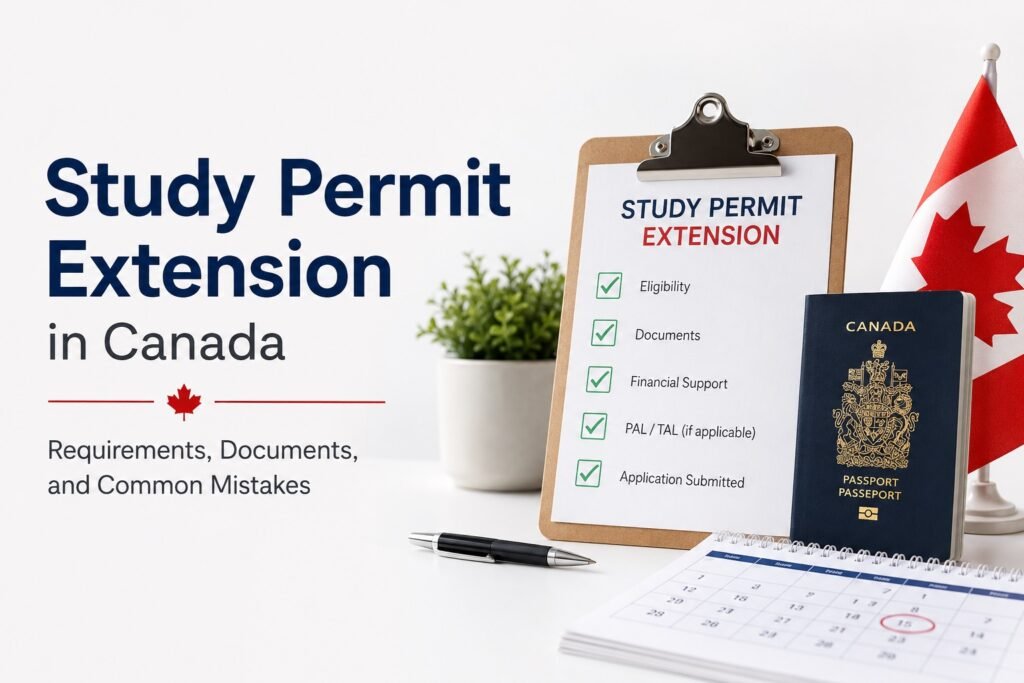
International students in Canada must remain authorized to study for the entire duration of their program. If a study permit will expire before the student completes their program, or if their educational circumstances change in a way that requires a new study permit or a change to existing conditions, they must apply to Immigration, Refugees and Citizenship Canada (IRCC) to extend or amend their study permit.
Study permit extension applications from within Canada are generally made using IRCC’s Application to Change Conditions, Extend My Stay or Remain in Canada as a Student (IMM 5709).
A study permit extension allows an international student in Canada to continue studying when their current permit will expire before they complete their studies. Students should apply before their existing study permit expires. If they submit a qualifying application on time and meet the applicable requirements, they may be able to remain in Canada and continue studying under maintained status while IRCC processes the application.
This guide is intended for international students in Canada who need to extend their study permit, including post-secondary students, minor children, and students changing schools or programs.
A study permit is generally issued for the length of the study program plus an additional 90 days. However, permits may be issued for shorter periods—for example, where passport validity is limited, where the program length is uncertain, or where IRCC imposes conditions. Students may also later require additional time to complete their program, transfer to another Designated Learning Institution (DLI), begin a different program, or receive a permit that expires earlier because of passport validity.
Applying for an extension is not simply a request for more time in Canada. IRCC will assess whether the student has complied with study permit conditions, including remaining enrolled at a designated learning institution (DLI), actively pursuing their course or program of study, maintaining adequate financial support, and holding a valid passport. Under section 220.1 of the Immigration and Refugee Protection Regulations (IRPR), study permit holders must remain enrolled at the DLI specified on their permit and actively pursue their studies.
This guide explains when a study permit extension may be required, when to apply (including how maintained status works), the documents commonly required, when a Provincial Attestation Letter (PAL) or Territorial Attestation Letter (TAL) is needed for extensions (including key exceptions), changing schools, financial evidence, passport validity, expired permits, and common mistakes that can lead to delays, refusals, or loss of status.
When Do You Need to Extend Your Study Permit?
The most straightforward situation is when a student is continuing the same program at the same designated learning institution (DLI) and level of study, but the existing study permit will expire before the program is completed. In many of these cases, no new Provincial Attestation Letter (PAL) or Territorial Attestation Letter (TAL) is required, provided the student meets an exception.
This can happen for several reasons. A program may take longer than originally expected, additional courses or semesters may be required, a co-op or academic schedule may change, or the permit may have been issued for a shorter period than the student’s remaining studies (for example, due to passport validity).
IRCC states that students who will not finish their studies before their permit expires must apply to extend their stay as students.
In practice, extensions arise in several different circumstances.
For example, in one matter we handled, a master’s student’s study permit was due to expire shortly before his program completion date. His final transcript would not be available until later, so the extension application documented his continuing enrolment, academic standing, and financial circumstances.
In another case, a student remained in the same Accounting diploma program at the same DLI and required additional authorization to continue until his expected graduation. The application included enrolment verification, an academic transcript showing progression and good standing, and evidence of continuing government scholarship funding.
Other situations can be more complicated, particularly where the student is changing DLIs, changing the level of study, has experienced interruptions in studies, or has previously been refused an extension or study permit.
The key point is that the documents and explanation must correspond to why the extension is actually required; extension applications should not be treated identically across different factual scenarios.
When Should You Apply for a Study Permit Extension?
For a student continuing at the school named on their study permit, IRCC instructs students to apply at least 30 days before the current permit expires and recommends applying more than 30 days in advance.
Waiting until the final days before expiry creates unnecessary risk. A missing document, payment problem, technical issue or incorrect application can become significantly more consequential when there is little time remaining.
Students should therefore check the expiry date printed on their actual study permit rather than assuming that their immigration status lasts until the date shown on their Letter of Acceptance or expected graduation date.
There is also an important distinction for minor children. IRCC currently recommends applying for a minor child’s new study permit at least 90 days before the existing permit expires.
What Is Maintained Status?
Maintained status, formerly commonly referred to as “implied status,” can allow a student to remain legally in Canada after their study permit expires while IRCC processes an application submitted before the permit’s expiry.
If a student applies to extend their study permit before it expires and IRCC has not made a decision by the expiry date, the student may remain in Canada as a temporary resident while the application is being processed.
However, maintained status does not automatically mean that every student can continue studying in every circumstance. Where the student applied to extend their study permit, they may generally continue studying under the conditions of their original study permit while awaiting a decision.
Maintained status does not renew the expired study permit itself. Rather, it preserves the student’s temporary resident status and, where applicable, the authorization to study under the conditions of the original permit until IRCC makes a decision.
When Can a Student Continue Studying on Maintained Status?
A student who applies to extend their study permit before it expires can generally continue studying while IRCC processes the application if they remain authorized to study under the conditions of their original permit.
This distinction is particularly important where the student is changing schools or changing immigration categories.
For example, a post-secondary student changing to a new Designated Learning Institution (DLI) generally needs to obtain a new study permit by applying to extend the current permit before beginning studies at the new DLI.
IRCC currently allows a student to begin studying at the new DLI while the application is being processed only in limited circumstances. The student must meet all of IRCC’s specified conditions, including circumstances where the previous DLI closed, discontinued the student’s program, was placed on the suspension list, or lost its designated status.
Accordingly, simply submitting a study permit extension before the existing permit expires does not necessarily authorize a student to begin studying at a different post-secondary DLI while waiting for a decision.
Similarly, a student who applies for a different type of temporary resident document should not assume that maintained status preserves the right to study. For example, IRCC states that a student who applies for a work permit instead of extending their study permit cannot continue studying after the existing study permit expires while waiting for the work permit decision.
When Maintained Status Does Not Allow Continued Study
Several situations require particular caution:
- The extension was submitted after the study permit expired. Maintained status does not arise. The student may need to apply for restoration and generally cannot study until student status has been restored and a new study permit issued.
- The application was rejected as incomplete. IRCC treats an application rejected as incomplete as though it was never submitted. If the original permit has already expired, the student may therefore need to apply for restoration.
- The student is changing to a new post-secondary DLI. Filing an extension does not, by itself, authorize the student to begin studying at the new DLI. Unless the student meets IRCC’s limited exception, the new study permit must be issued before studies begin at the new institution.
- The student applied for a different type of permit. Applying for another immigration document may maintain temporary resident status, but it does not necessarily preserve authorization to study after the existing study permit expires.
These distinctions are important because maintaining legal temporary resident status and maintaining authorization to study are related but not always identical questions.
Maintained Status vs. Restoration of Status
Maintained status should not be confused with restoration.
Maintained status generally arises when an eligible application to extend or change the conditions of stay is submitted before the existing temporary resident status expires. In the case of a qualifying study permit extension, the student may continue studying under the conditions of the original study permit while IRCC processes the application.
Restoration of status applies after temporary resident status has already been lost. A student who did not apply for an extension before their study permit expired may generally apply for restoration within 90 days of losing status, provided they meet the applicable requirements.
A student applying for restoration may remain in Canada while IRCC processes the application, but cannot study until their student status has been restored and the new study permit has been issued.
Travel While a Study Permit Extension Is Processing
A student may leave Canada while an application to extend their study permit is being processed. Leaving Canada does not, by itself, cancel the pending study permit extension application, and IRCC can continue processing the application while the student is outside Canada.
However, travelling can affect the student’s ability to return to Canada and continue studying.
If the study permit extension is still being processed when the student returns, the student may be allowed to enter Canada as a visitor, provided they otherwise meet the requirements for entry. In that situation, the student cannot resume studying until IRCC approves the study permit extension.
If IRCC approves the study permit extension while the student is outside Canada, the student may seek re-entry as a student. To return to Canada, they must have the appropriate valid travel document—such as a Temporary Resident Visa (TRV) or electronic travel authorization (eTA), where required—in addition to the approved study permit or evidence of approval, and must continue to meet Canada’s entry requirements.
A study permit itself is not a travel document, and approval of a study permit extension does not by itself guarantee admission to Canada. The final decision on admission is made at the port of entry.
What Documents Are Required for a Study Permit Extension?
There is no single document package appropriate for every student. The personalized IRCC document checklist and the student’s circumstances should determine what is submitted.
However, a well-supported application will commonly include:
- a valid passport and relevant passport pages;
- the current study permit;
- a Letter of Acceptance or current proof of enrolment from the DLI;
- academic transcripts or other evidence of academic standing and progression;
- a PAL/TAL, where required, or evidence supporting an exemption;
- proof of tuition payment, where available;
- evidence of sufficient financial support;
- documents explaining a change of school, program, academic interruption or other unusual circumstances, where applicable;
- IMM 5709 and other forms generated or required for the particular application; and
- IMM 5476 where an authorized representative is being appointed.
IRCC’s current Guide 5552 specifically identifies proof of acceptance or enrolment and proof of academic standing as relevant documents for study permit renewal applications.
The supporting documents will vary depending on the student’s circumstances. For example, an application involving a transfer to a new institution may include an LOA, PAL/TAL where required, previous academic transcripts, the current study permit, proof of tuition payment, and parental financial evidence. Another application may rely primarily on proof of enrolment, academic transcripts, and evidence of scholarship funding.
The objective should therefore not be to upload as many documents as possible. It should be to provide documents that establish the relevant requirements and clearly explain the student’s particular circumstances.
Proof of Enrolment and Academic Progress
A study permit holder must do more than simply possess an unexpired permit. IRPR 220.1 requires the holder to remain enrolled at the DLI named in the permit and actively pursue their studies.
For an extension, academic evidence can therefore be important.
Depending on the circumstances, this may include an enrolment letter, transcript, confirmation of full-time registration, expected completion date, or documentation explaining an interruption or change in academic progression.
A weak academic history does not automatically mean that an extension application should simply avoid discussing it. If there are significant gaps, withdrawals, failed courses, changes of program or other circumstances that may raise questions about whether the student has been actively pursuing studies, those circumstances may need to be addressed with appropriate evidence and explanation.
Academic interruptions or changes in study direction should be explained in context. Where a student has experienced an interruption in academic progression before transferring to a different program, the application may need to document the previous studies, explain the interruption, and establish the rationale for the new academic pathway.
The explanation should be factual and supported by the record. It should not attempt to disguise an academic history that IRCC can independently verify.
Changing Your DLI: The Rules Have Changed
This is one of the most important areas for students to understand because the rules for post-secondary DLI changes are substantially different from the system that existed previously.
A post-secondary student who wants to change to another DLI generally needs to obtain a new study permit by applying to extend the current study permit. The new institution must be a DLI.
Important: Since November 8, 2024, most post-secondary students who change designated learning institutions (DLIs) must apply for and obtain a new study permit before beginning studies at the new institution. Updating the DLI through an IRCC online account is no longer available as a substitute for a new permit application
The extension application should generally include the new school’s Letter of Acceptance, an explanation for the change, and a new PAL/TAL where required. Since January 22, 2025, students changing schools who require a PAL/TAL must obtain a new one before submitting the application.
There are limited circumstances in which a student may begin studying at the new DLI while IRCC processes the application. Those exceptions should be assessed carefully rather than assumed.
Do You Need a PAL or TAL for a Study Permit Extension?
Not always.
The PAL/TAL rules are now highly dependent on the student’s circumstances.
A student who has entered Canada and is applying to extend a study permit at the same DLI and the same level of study is currently exempt from providing a PAL/TAL. However, proof that the exemption applies should be included with the application.
A new PAL/TAL is generally required when a student changes to a different DLI or changes the level of study, unless another exemption applies. IRCC also provides specific exemptions for certain categories, including primary and secondary students and, beginning January 1, 2026, students in degree-granting master’s or doctoral programs at public DLIs.
Students applying for restoration should be especially careful: IRCC states that a new PAL/TAL is required when restoring student status, even if the student intends to continue at the same DLI and level, unless another PAL/TAL exemption applies.
Where an exemption is claimed, do not simply leave the PAL/TAL upload unexplained. IRCC instructs applicants to provide evidence supporting the exemption.
For example, an application checklist for a minor studying at the primary-school level may generate a required “Proof of Provincial or Territorial Attestation Letter (PAL or TAL) Exception” field. Where that field appears, the applicant should provide evidence supporting the applicable exemption rather than an unrelated document.
Proof of Financial Support
Financial capacity remains an important part of a study permit extension application.
The evidence will depend on who is funding the student’s education. It may include personal bank statements, scholarship documentation, tuition receipts, proof of employment or income, or financial support from parents or another sponsor.
Where another person is providing the funds, the application should make the arrangement understandable. Evidence may include a declaration or letter of financial support, proof of the relationship and documents demonstrating that the sponsor actually has access to the funds.
Financial support may be documented in different ways depending on the student’s circumstances. Where parents are providing support, evidence may include a statutory declaration, proof of relationship, bank statements, income or business documents, and other evidence showing the availability of funds. In other cases, financial capacity may be demonstrated through government scholarship funding together with the student’s own funds.
IRCC recognizes several forms of financial evidence, including bank documentation, letters from persons or institutions providing funds accompanied by evidence of those funds, and proof of scholarship support.
The key is not simply showing a large balance. The documentation should allow the officer to understand who controls the funds, their source where relevant, whether they are available to the student, and how they will support the student’s tuition and living expenses for the remaining period of study.
Passport Validity Can Limit the Extension
Before applying, students should check their passport expiry date.
IRCC cannot extend a study permit beyond the validity of the passport. A student requesting several additional years of study with a passport expiring much earlier may therefore receive a study permit ending with the passport rather than the anticipated program completion date.
Where practical, renewing a passport before submitting a long extension application can avoid having to submit another extension solely because the passport limited the validity of the permit.
What If You Need More Time Only to Finish Your Program?
Not every extension involves a new school or a new program.
A student may simply discover that their permit expires shortly before the remaining semester or program requirements are completed. In that situation, the application should make the timeline clear: current permit expiry, current enrolment, remaining academic requirements and expected completion date.
For example, a student may be approaching the end of a program but have a study permit that expires before the expected completion date. In such a case, current proof of enrolment and academic transcripts can help establish that the student is completing the remaining requirements of the existing program.
This type of extension is fundamentally different from an application involving a new DLI or a new academic pathway, and the explanation should reflect that.
Study Permit Extensions for Minor Children
Minor children require separate consideration.
Some minor children already in Canada are authorized to attend preschool, primary or secondary school without holding a study permit—for example, in certain circumstances where a parent is authorized to work or study in Canada. Nevertheless, IRCC encourages minors to obtain study permits in many situations because holding one can provide continuity of status and other practical benefits.
For an in-Canada extension, IRCC states that minor children need a Letter of Acceptance, and the duration of the permit is based on that letter. Primary and secondary school students are also exempt from the PAL/TAL requirement.
The portal checklist for a minor child can look quite different from that of an adult post-secondary student. Depending on the circumstances, it may request documents such as proof of relationship, school enrolment, the parent’s proof of status, and evidence supporting a PAL/TAL exemption.
Another scenario may arise where dependent children require study permit extensions to continue their education and maintain temporary resident status while their family’s permanent residence application is being processed.
Minor-child study permit applications involve additional considerations that are beyond the scope of this study permit extension guide and will be addressed separately.
What Happens If Your Study Permit Has Already Expired?
An extension and restoration are not the same thing.
If the study permit expired after the student submitted a qualifying extension application, the student may have maintained status while IRCC processes the application.
If the permit expired before an extension application was submitted, the student generally loses student status. IRCC currently provides a 90-day period in which an eligible person may apply to restore their status as a student. They generally cannot continue studying until status has been restored and a new study permit has been issued.
This distinction is critical. An applicant who has lost status should not submit the application as though they were simply extending an unexpired permit.
Restoration requires the appropriate application selection, explanation, documentation and fees. IMM 5709 specifically requires an applicant seeking restoration to select both restoration of temporary resident status as a student and the initial/extension study permit option.
Previous Refusals and Study Permit Extension Applications
A previous refusal does not necessarily prevent a student from submitting another application, but the refusal should not simply be ignored.
The appropriate response depends on why the earlier application was refused.
Sometimes the new application needs stronger evidence. In other circumstances, the refusal may appear to have resulted from a misunderstanding or an incorrect factual assessment.
A reapplication should therefore address the actual refusal concern rather than merely resubmitting substantially the same application.
Common Study Permit Extension Mistakes
Many study permit extension problems are avoidable. Common mistakes include:
- Applying too close to the study permit expiry date.
- Assuming that a Letter of Acceptance or enrolment letter extends immigration status.
- Failing to provide evidence of enrolment, academic progression, or an explanation for significant gaps in studies.
- Changing a post-secondary DLI without obtaining the required new study permit.
- Omitting a required PAL/TAL or failing to provide evidence of a PAL/TAL exemption.
- Requesting a permit validity period that exceeds passport validity.
- Providing financial documents without clearly showing the source, control, and availability of funds.
- Confusing a study permit with a TRV or other document needed to travel and seek re-entry to Canada.
- Treating an application made after permit expiry as an ordinary extension rather than a possible restoration application.
Another common problem is using a generic explanation for a non-generic case. An uncomplicated extension to finish one remaining semester does not require the same explanation as a student transferring institutions after an academic interruption. Conversely, a complicated academic history should not be presented as though nothing changed.
The application should tell one coherent story that is consistent with the forms, immigration history, academic records and supporting evidence.
Frequently Asked Questions
Can I continue studying after my study permit expires if I applied for an extension?
Generally, yes, if you submitted the study permit extension before the existing permit expired and otherwise meet the requirements for maintained status. You may remain in Canada and continue studying under the conditions of the original study permit while IRCC decides the application.
How early should I apply?
IRCC says students continuing at the same school should apply at least 30 days before expiry and recommends applying more than 30 days in advance. Minor children are advised to apply at least 90 days before their current permit expires.
Do I need a new PAL for an extension?
It depends. If you have entered Canada and are extending at the same DLI and same level of study, you are generally exempt. If you are changing DLIs or changing levels of study, a new PAL/TAL is generally required unless another exemption applies.
Can I change colleges while my study permit is valid?
For post-secondary students, changing DLIs generally now requires a new study permit obtained by applying to extend the existing permit. Do not rely on the old process of simply updating the DLI in an online account.
Can IRCC extend my study permit beyond my passport expiry?
No. The validity of the study permit cannot exceed the validity of the passport.
Does extending my study permit automatically renew my visitor visa?
No. A study permit is not a travel document, and renewing the permit does not by itself renew an existing TRV. Students planning international travel should separately verify their travel-document requirements.
What if my study permit has already expired?
If you did not apply before expiry, you may be eligible to apply for restoration within 90 days of losing status. You generally cannot continue studying until your student status has been restored and the new study permit issued.
Final Thoughts
A study permit extension may appear straightforward, but the appropriate application depends on why additional authorization is required.
A student continuing the same program, a student transferring to a new DLI, a student whose academic progress has been interrupted, and a minor child extending status while a parent remains in Canada can all be submitting what the portal calls a study permit extension, while requiring materially different supporting evidence.
The safest approach is to identify the student’s current status, study permit expiry date, present DLI and program, academic history, future studies, PAL/TAL requirement or exemption, passport validity and financial arrangements before preparing the application.
Most importantly, students should not wait until their existing study permit has expired. Applying early provides time to address documentation issues and, where the requirements are met, preserves the student’s ability to remain in Canada under maintained status while IRCC processes the application.
Need Help With a Study Permit Extension?
A study permit extension should be prepared around your actual circumstances—not a generic checklist. If your permit is expiring soon, you are changing schools or programs, need restoration of status, or have had a previous refusal, professional advice can help you assess the appropriate next steps.
Considering permanent residence after your studies?
Explore our Express Entry guides covering R10 completeness, A11.2 assessment, NOC selection, work experience, and employment documentation. Learn how IRCC assesses eligibility and supporting evidence, and the common issues that can affect an Express Entry application.