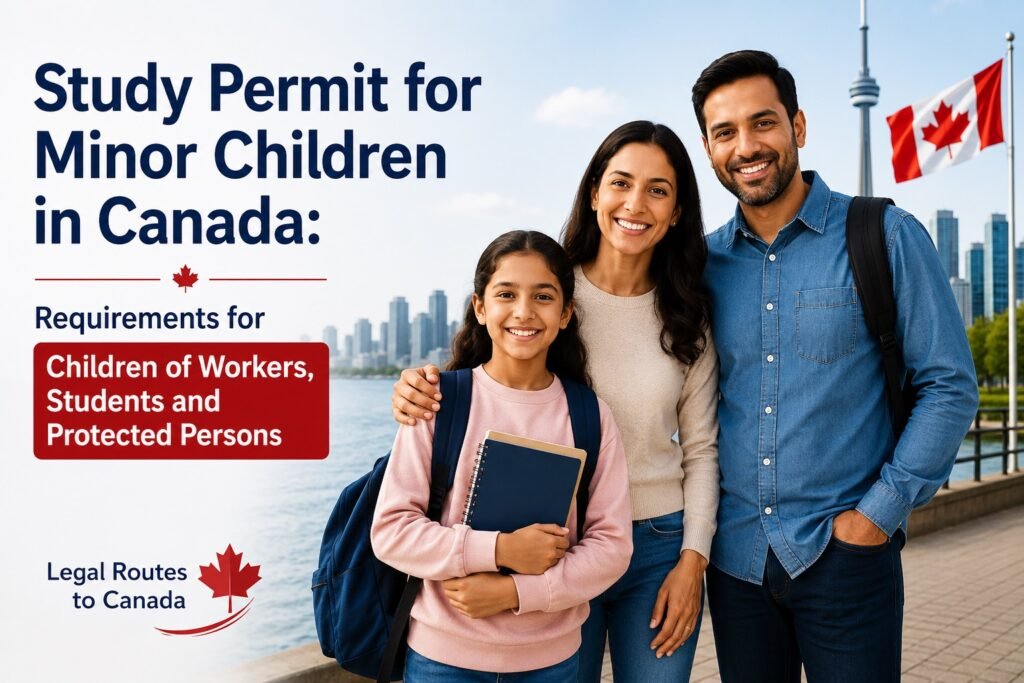
When a parent comes to Canada to work or study, one of the most important questions is often how their minor child can accompany them or join them later.
The same question can arise in much more difficult circumstances. A parent may have been recognized as a protected person in Canada while their child remains abroad, sometimes living with grandparents or other relatives while the family’s permanent residence application is being processed.
A study permit for a minor child in Canada can be relevant in each of these situations. However, the requirements for minor children studying in Canada depend on the child’s age, location, proposed schooling and the immigration circumstances of the parents, including whether the child needs a study permit, letter of acceptance, custodianship documents or other supporting evidence.
This guide focuses primarily on minor children applying from outside Canada to accompany or reunite with a parent who is a work permit holder, study permit holder or protected person in Canada.
It explains the current requirements, documents and application process, as well as some of the special considerations that arise when a child is separated from a parent who is already living in Canada.
Important: A child’s application should be prepared according to the family’s actual circumstances. The requirements for a child accompanying a worker may not be identical to those for a child joining a protected-person parent while permanent residence is being processed.
1. Who Is Considered a Minor Child in Canada?
For immigration purposes relating to studying in Canada, the age at which a person becomes an adult depends on the province or territory where they will study.
The age of majority is either 18 or 19, depending on the province or territory.
This matters because special rules apply to minor children, particularly regarding their care and custodianship when they will be studying in Canada without a parent or legal guardian.
For example, IRCC’s current guidance requires children 17 years of age or younger who come to Canada without a parent or legal guardian to have appropriate arrangements for their care in Canada. Children between age 17 and the applicable age of majority may also require a custodian at an immigration officer’s discretion.
Later in this guide, we explain the difference between custodianship, parental consent and custody documents, because these are not the same thing.
2. Does a Minor Child Need a Study Permit to Study in Canada?
The answer depends partly on whether the child is outside Canada or already in Canada.
Minor Children Applying From Outside Canada
A minor child who is outside Canada and intends to come to Canada to study will generally need to apply for a study permit before travelling to Canada when a study permit is required.
This is particularly important where a child will accompany a parent coming to Canada to work or study, or will join a parent who is already living in Canada.
IRCC’s guidance for families applying for work permits also specifically states that children who plan to join a parent at a later date must apply for their study permit before coming to Canada.
A study permit is therefore often part of the family’s immigration planning rather than a completely separate educational application.
Minor Children Who Are Already in Canada
The rules can be different once the child is physically in Canada.
IRCC currently provides that a minor child may study at the preschool, primary or secondary level in Canada without a study permit in several circumstances, including where:
- the child is a refugee or refugee claimant;
- the child’s parents are refugees or refugee claimants;
- the child is already in Canada with a parent who is authorized to work or study in Canada; or
- the child is in Canada unaccompanied and attending preschool, primary or secondary school.
IRCC nevertheless explains that obtaining a study permit can still provide advantages in some circumstances, including continuity when the child reaches the age of majority and access to certain programs or services.
This article focuses mainly on children applying from outside Canada, so families whose children are already physically present in Canada should first determine whether a study permit is actually required in their particular circumstances.
If a child already holds a study permit that is approaching expiry, an application to extend their study permit in Canada should generally be submitted before the current permit expires.
3. Study Permit for a Child of a Work Permit Holder
A parent who has been approved to work in Canada may want their child to accompany them immediately or join them after the parent has settled in Canada.
For a school-aged child coming from outside Canada, a study permit application may be made so that the child can live with the parent and attend school in Canada.
The application should establish the family relationship and clearly document the parent’s Canadian immigration circumstances.
Depending on the particular case, useful documents may include:
- the child’s birth certificate showing the parent-child relationship;
- copies of the parents’ passports;
- the parent’s work permit or work permit approval letter;
- evidence of the parent’s employment in Canada;
- the child’s passport;
- school records from the child’s current or previous school;
- Canadian school documentation, where required or available;
- financial documents showing how the child’s expenses will be supported; and
- custody or parental-consent documentation where applicable.
If both parents are in Canada, it can also be useful to document the status of both parents rather than providing information about only the parent who is principally supporting the application.
When the Child Is Joining the Parents Later
There is nothing unusual about a parent travelling to Canada first and a child applying later.
But the application should explain the actual family circumstances rather than leaving the officer to determine why the child remained abroad and why the child is now joining the parent.
For example, one case involved a school-aged child whose parents were both already lawfully working in Canada. The child had remained abroad without either custodial parent and subsequently applied for a study permit to join them and continue her schooling in Canada.
The application explained the parents’ immigration status, the child’s living arrangements abroad, her proposed schooling and why reunification with her parents was appropriate. It did not attempt to manufacture an adult-style career objective for a school-aged child.
That distinction is important.
For a young child, the purpose of studying in Canada may simply be to continue ordinary primary or secondary education while living with their parents. The explanation should still be complete and credible, but it should make sense for the child’s age.
4. Study Permit for a Child of a Study Permit Holder
A similar situation can arise when a parent comes to Canada as an international student.
A dependent child may accompany the parent or join the parent later and attend preschool, primary or secondary school in Canada.
Again, the child’s application should establish the relationship to the parent and the parent’s authorization to study in Canada.
Documents may include the parent’s:
- study permit or approval letter;
- letter of acceptance or proof of enrolment;
- passport and immigration documents;
- evidence of financial resources; and
- information about where the family will live in Canada.
The child’s own identity, schooling and family documents should also be included as applicable.
Families should not assume, however, that every document requirement is identical simply because the child is accompanying a parent with temporary resident status. Two particularly important questions are whether the child requires a letter of acceptance and whether a PAL/TAL is required.
5. Does a Minor Child Need a Letter of Acceptance (LOA)?
This is one area where families should be particularly careful because the answer can depend on the circumstances.
As a general rule, IRCC requires a letter of acceptance from the school when applying for a study permit. However, IRCC currently provides an important exception for certain accompanying family members.
If the child is the family member of a person whose work permit or study permit application has been approved in writing before the child comes to Canada, IRCC states that the child does not need a letter of acceptance for the study permit application.
That exception can be particularly relevant where a family is applying together or a child is accompanying a parent whose Canadian work or study authorization has already been approved.
However, families should not turn this into a blanket rule that “minor children never need an LOA.” That is incorrect.
The child’s particular circumstances and IRCC’s instructions for the application must be checked.
This is especially important for children of protected persons, which we discuss separately below. In actual protected-person permanent residence correspondence reviewed for this guide, IRCC expressly advised the parent that an overseas dependent could apply for a study permit and instructed the family to include a letter from the educational institution identifying the program, start date and expected completion date.
Therefore, if IRCC has sent the family a letter containing specific instructions concerning an overseas child, those instructions should be reviewed carefully rather than assuming that an LOA exception applicable in another situation automatically applies.
6. Does a Minor Child Need a PAL or TAL?
Children attending preschool, primary school or secondary school up to Grade 12 are generally exempt from the PAL/TAL requirement.
IRCC currently lists applicants studying at the following levels among the PAL/TAL exemptions:
- preschool;
- primary school, including kindergarten; and
- secondary school up to Grade 12.
This is an important distinction from many post-secondary study permit applications, where a PAL/TAL is generally required unless another exemption applies.
Where the child is exempt, the application should still be prepared according to the document checklist generated for that child’s circumstances. IRCC notes that applicants relying on a PAL/TAL exception must provide evidence that they meet the applicable exemption.
For a typical school-aged child, the child’s age and proposed primary or secondary education will normally make the basis of the exemption apparent from the application and supporting school documentation.
7. Can a Protected Person in Canada Apply for a Study Permit for Their Child Abroad?
Yes, a study permit may be an available temporary-residence pathway for an overseas child in some protected-person families while permanent residence processing is ongoing.
This deserves its own section because the circumstances can be very different from those of a typical international student.
A person recognized as a protected person in Canada may subsequently apply for permanent residence and include eligible family members living outside Canada in that process. Permanent residence processing, however, can take time.
During that period, a minor child may remain abroad with a grandparent, relative or other caregiver while one or both parents are living in Canada.
In one protected-person case, IRCC issued an eligibility letter on February 3, 2025, confirming that an overseas child included in the parent’s permanent residence application had met the applicable eligibility requirements. Under the heading “Applying for an open work permit and/or study permit,” IRCC expressly advised that a study permit could be applied for and instructed that the application include a letter from the educational institution identifying the program, start date and expected completion date.
In another protected-person case, IRCC issued a similar eligibility letter on July 24, 2025 for a family with two children outside Canada. The letter confirmed that the children included in the permanent residence application had met the applicable eligibility requirements and again expressly advised that a study permit could be applied for while providing the same educational-document instructions.
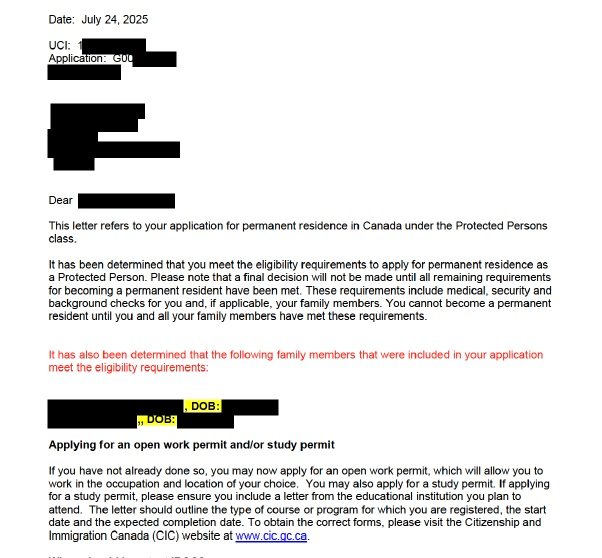
This is significant because a parent should not automatically assume that the child must remain abroad until the permanent residence application is finalized.
At the same time, the existence of a pending permanent residence application does not mean that a study permit will automatically be approved. The temporary residence application must still satisfy the applicable requirements and will be assessed on its own facts.
When the Child Is Living With Grandparents or Other Relatives
The child’s actual living arrangements can be highly relevant.
In one successful case, an 11-year-old child remained abroad with grandparents while both parents were in Canada and the family’s permanent residence processing continued. The study permit application explained the separation, the child’s current care arrangements and the parents’ circumstances in Canada.
Another case involved two young siblings whose parents were protected persons in Canada. The children were living separately with different relatives abroad while the family’s immigration processing continued. The application explained those caregiving arrangements and the effect of the prolonged family separation rather than presenting the matter simply as an educational choice.
These circumstances illustrate why the supporting explanation for a minor child should reflect the family’s reality.
A parent does not need to disguise the fact that they want to live with their child. The application can explain both the child’s proposed schooling and the family circumstances that make reunification important, while still addressing the legal requirements applicable to temporary residence.
Best Interests of the Child and Family Separation
Where a child has been separated from one or both parents, the application can also explain how that separation affects the child’s particular circumstances.
Canadian immigration jurisprudence has repeatedly recognized the importance of examining children’s interests carefully where those interests are legally engaged.
In Kanthasamy v. Canada (Citizenship and Immigration), 2015 SCC 61, the Supreme Court of Canada considered the best interests of the child in the context of an application for humanitarian and compassionate relief. The Court explained that where the legislation specifically requires the best interests of a directly affected child to be considered, those interests are a “singularly significant focus and perspective.”
Earlier, in Legault v. Canada (Minister of Citizenship and Immigration), 2002 FCA 125, the Federal Court of Appeal emphasized the need to properly identify, define and carefully examine the interests of the affected child. Importantly, the jurisprudence does not establish that a child’s best interests automatically determine the outcome; they must be considered within the applicable legal framework.
Similarly, Hawthorne v. Canada (Minister of Citizenship and Immigration), 2002 FCA 475 recognized that assessing a child’s interests involves considering both the benefit to the child of remaining with a parent and the hardship associated with separation.
These cases arose in the humanitarian and compassionate context, rather than ordinary study permit applications. They should therefore not be read as creating an automatic right to a study permit based on family separation or the best interests of the child.
They nevertheless illustrate why, where family separation forms an important part of a minor child’s circumstances, it should be explained with evidence rather than mentioned only in passing.
Depending on the case, the application may explain:
- the child’s age and level of dependency;
- how long the child has been separated from the parent or parents;
- who is currently caring for the child;
- whether the caregiving arrangement is temporary;
- whether siblings are also separated;
- the child’s schooling and educational needs;
- the proposed care and living arrangements in Canada; and
- any particular circumstances affecting the child’s well-being.
For example, the 11-year-old child’s application reviewed for this article specifically addressed her stage of development, separation from both parents, current residence with her grandparents and the importance of transitioning into school in Canada.
The purpose of providing this information is not to argue that family reunification alone guarantees approval. It is to ensure that the officer has a complete and accurate picture of the child’s circumstances when assessing the application.
What if the Protected-Person Parent Has Sole Custody?
Custody should be documented clearly.
One of the cases reviewed for this guide involved a nine-year-old child living with her grandmother abroad while her mother, a protected person in Canada, held sole legal custody following the parents’ separation.
In that type of situation, relevant evidence may include:
- divorce or separation documents;
- custody orders;
- evidence of sole parental responsibility;
- the child’s birth certificate;
- information about the child’s present caregiver;
- the parent’s Canadian immigration documents; and
- any IRCC correspondence concerning the child in the family’s permanent residence application.
The objective is not simply to upload more documents. It is to make the child’s legal and practical care arrangements understandable from the file.
Permanent Residence and Temporary Residence Can Exist Together
A pending permanent residence application does not necessarily prevent a person from seeking temporary residence in Canada.
For a protected-person family, it is particularly important to be transparent about the pending PR process rather than trying to conceal it.
The application can explain that the child is included in permanent residence processing while also seeking temporary authorization to come to Canada and attend school during that period.
The fact that IRCC’s own correspondence in the protected-person files reviewed for this article expressly contemplated a study permit application while the overseas children were included in PR processing is particularly useful in understanding how the two processes can coexist.
We discuss temporary intent and dual intent for minor children separately below.
8. Does a Minor Child Need a Custodian in Canada?
A custodian is a responsible adult in Canada who is appointed to care for and support a minor child when the child’s parent or legal guardian will not accompany them.
For children 17 years of age or younger coming to Canada to study without an accompanying parent or legal guardian, IRCC requires appropriate custodial arrangements. The custodian must live in Canada, be a Canadian citizen or permanent resident, and be at least 19 years old.
Children between age 17 and the age of majority in the province or territory where they will study may also be required to have a custodian at an officer’s discretion.
Where custodianship is required, the parents or legal guardians and the proposed custodian generally complete IMM 5646 – Custodianship Declaration. Both parts of the declaration must be notarized.
Is a Custodian Required if the Child Will Live With a Parent in Canada?
Generally, no.
If the child will accompany or join their parent or legal guardian in Canada, a separate Canadian custodian is generally not required. However, the application should clearly establish who will care for the child in Canada, where the child will live, and who will be responsible for the child’s financial support, education, health and general well-being. A parental declaration or other supporting documentation can be provided to explain these arrangements.
This distinction is particularly important for the families discussed in this guide. A child joining a mother or father who is working, studying or living in Canada as a protected person is not in the same position as an unaccompanied international student whose parents will remain abroad.
9. What if Only One Parent Is Travelling With the Child?
Custodianship and parental consent are different issues.
IRCC’s current Guide 5269 expressly states that custodianship is not mandatory merely because a minor travels with only one parent. However, the family should provide signed consent from the non-accompanying parent.
Depending on the circumstances, the application may include:
- a consent letter from the non-accompanying parent;
- a copy of that parent’s government-issued identification;
- the child’s birth certificate identifying the parents;
- custody or decision-making responsibility documents;
- divorce or separation documents;
- a court order;
- an adoption order, where applicable; or
- a death certificate if the other parent is deceased.
IRCC has specific guidance for lone-parent applications. Where one parent has sole custody, IRCC asks for documents establishing both the parent-child relationship and the parent’s decision-making authority. Where parents share decision-making authority, the non-accompanying parent’s notarized consent and identification should be provided.
This is an area where the documents should match the family’s actual legal circumstances.
For example, if a court order gives one parent sole custody, the application should not simply state that the other parent has provided consent. The custody order itself may be the more important evidence.
Similarly, if the other parent is deceased, that fact should be documented rather than leaving an unexplained absence in the application.
Practical point: Keep copies of custody and parental-consent documents available when the child travels as well. Visa-office instructions may specifically require these documents to be available for presentation at the Canadian port of entry.
10. Does a Minor Child Need a Study Plan?
IRCC recommends a letter of explanation for study permit applications explaining why the applicant wants to study in Canada and demonstrating an understanding of the responsibilities associated with studying in Canada.
For a minor child, however, the explanation should be appropriate to the child’s age and circumstances.
An eight-year-old coming to Canada to attend elementary school does not ordinarily have the same academic or career objectives as an adult applying for a college diploma or university degree. This distinction has also been recognized by the Federal Court.
In Naghianfesharaki v. Canada (Citizenship and Immigration), 2023 FC 1489, the applicant was a seven- or eight-year-old child who applied for a study permit to attend Grade 2 at a Canadian public school. The visa officer questioned the reasonableness of the child’s proposed studies based partly on her “employment and education history,” “career path,” and the absence of a study plan explaining the benefits of studying Grade 2 internationally.
The Federal Court found the decision unreasonable. The Court rejected an approach that would effectively require a young elementary-school applicant to demonstrate exceptional abilities, specialized training or similarly unusual educational circumstances simply to justify studying in Canada. The Court confirmed that foreign children may lawfully apply for Canadian study permits at the elementary-school level and stated that “There is no requirement that they have special educational needs.”
This does not mean that no explanation should be provided for a minor child’s proposed studies. Rather, the explanation should make sense for the child’s age and actual circumstances.
For a child accompanying or joining a parent in Canada, the explanation can address matters such as:
- the child’s age and current grade;
- current schooling abroad;
- where and with whom the child is presently living;
- the parent’s immigration status in Canada;
- why the child will accompany or join the parent;
- the child’s proposed school or level of education in Canada;
- who will care for and financially support the child;
- whether the child has been separated from one or both parents; and
- any pending permanent residence process involving the child.
For a young child, continuing ordinary primary or secondary education while living with their parent may itself be a genuine and understandable study purpose. There is little value in manufacturing an elaborate adult-style career plan that does not reflect the child’s age or circumstances.
In one successful application reviewed for this guide, a school-aged child was joining both parents who were already working in Canada. The application explained that the child’s purpose was to continue regular schooling while living with her parents. The explanation focused on her age, education and family circumstances rather than attempting to construct an artificial long-term career objective.
Who Should Write the Explanation?
For a young child, it is entirely reasonable for the explanation to be presented from the parent’s perspective.
A parent can explain the family circumstances, schooling arrangements, financial support and immigration history clearly and truthfully.
For an older teenager, the child’s own educational background, interests and reasons for the proposed studies may naturally become more relevant.
11. Temporary Intent and Dual Intent for Minor Children
A study permit is a form of temporary resident authorization. An applicant must satisfy the officer that they will leave Canada when their authorized stay ends.
This can appear complicated where a child is already included in a parent’s permanent residence application. However, Canadian immigration law recognizes dual intent. Under section 22(2) of the Immigration and Refugee Protection Act (IRPA), an intention to become a permanent resident does not prevent a person from obtaining temporary status, provided the officer is satisfied that the temporary-residence requirements will be respected.
The Federal Court addressed a similar principle in Mahida v. Canada (Citizenship and Immigration), 2019 FC 423. The Court found there was “nothing inherently illogical” about an applicant wanting eventually to live in Canada while maintaining a different intention in the meantime.
For protected-person families, the pending PR application should therefore be disclosed and explained rather than concealed. The application can state that the child is included in permanent residence processing while seeking temporary authorization to join the parent and attend school in Canada.
This is also consistent with the actual IRCC correspondence reviewed for this guide. IRCC was aware that overseas children were included in protected-person permanent residence processing and nevertheless expressly advised that a study permit could be applied for.
This does not guarantee approval. The child must still satisfy the applicable study permit and temporary-residence requirements. For a young child, the explanation should reflect the child’s actual age, family circumstances and dependency on their parents rather than relying on generic statements written for an adult international student.
12. Proof of Financial Support for a Minor Child
A study permit application must demonstrate that sufficient financial resources are available for the applicant’s studies and stay in Canada.
IRCC’s current study permit requirements address tuition, living expenses and transportation. IRCC also makes clear that applicants do not need to submit every possible type of financial document; the evidence should demonstrate that the required resources are genuinely available.
For a dependent minor child, the financial picture will often be based primarily on the parents’ resources.
Depending on the family’s circumstances, evidence may include:
- Canadian or foreign bank statements;
- the parent’s employment letter;
- recent pay statements;
- Canadian tax documents, where available;
- evidence of the parent’s work authorization;
- savings or fixed deposits;
- evidence of business or self-employment income;
- proof of accommodation in Canada;
- evidence of tuition or school fees already paid, where applicable;
- a letter explaining who will pay the child’s expenses; and
- financial evidence from another supporter, if someone other than the parents will provide support.
IRCC’s current proof-of-funds guidance lists bank accounts, bank statements, education loans, proof of tuition/housing payments, GICs and letters from persons providing financial support among possible forms of evidence.
The strongest financial package is not necessarily the one containing the largest number of documents.
For example, if a parent is already employed in Canada, the application can clearly show the parent’s current employment, income, available savings, housing arrangements and responsibility for the child’s expenses.
If the family relies on funds abroad, the application should make it easy to understand where those funds come from and how they are available for the child’s support.
Applicants should also check the visa-office instructions applicable to the country or region where the application is being processed, because additional local financial documentation may be requested.
13. Documents for a Minor Child Study Permit Application
There is no single document package that will be identical for every minor child.
The online document checklist and applicable visa-office instructions should always be reviewed before submission.
However, the following provides a useful DIY checklist for a child applying from outside Canada to accompany or join a parent.
Child’s Identity and Family Documents
Consider including, as applicable:
- valid passport;
- birth certificate;
- passport-size digital photograph meeting IRCC specifications;
- previous passports, where relevant;
- adoption documents, if applicable; and
- documents establishing the relationship to the parent in Canada.
School and Educational Documents
Depending on the child’s circumstances:
- letter of acceptance, if required;
- school admission or registration correspondence;
- current or previous school records;
- report cards or transcripts;
- evidence of the child’s current grade;
- information about the proposed Canadian school; and
- PAL/TAL exemption evidence where relevant.
Remember that an LOA is not required in every minor-child situation, as explained earlier in this guide. The family’s specific circumstances and IRCC instructions should determine what is provided.
Parent’s Canadian Immigration Documents
Where the child is accompanying or joining a parent:
- parent’s passport;
- work permit or work permit approval;
- study permit or study permit approval;
- proof of enrolment if the parent is studying;
- protected-person documentation, where applicable;
- permanent residence correspondence, where relevant;
- evidence of the parent’s Canadian address; and
- evidence of the parent’s employment or other activities in Canada.
Where both parents are in Canada, documents relating to both parents can help present a complete picture.
Financial Documents
Depending on the source of support:
- bank statements;
- employment letter;
- pay statements;
- tax documents;
- savings or investment evidence;
- business or self-employment documents;
- proof of tuition payments;
- accommodation evidence; and
- financial support letter where appropriate.
Custody and Parental-Consent Documents
Depending on the family:
- notarized consent from the non-accompanying parent;
- government-issued identification of the consenting parent;
- custody order;
- divorce or separation order;
- decision-making responsibility documents;
- death certificate;
- adoption order; or
- other legal documentation explaining parental authority.
IRCC’s current lone-parent guidance specifically distinguishes sole-custody, joint-custody, absent-parent and deceased-parent situations, so families should provide the evidence applicable to their actual circumstances.
Custodianship Documents
If the child will come to Canada without a parent or legal guardian and custodianship is required:
- IMM 5646;
- notarized declaration from the Canadian custodian;
- notarized declaration from the parent/legal guardian; and
- supporting identification as required.
Explanation Letter
The parent can prepare a clear explanation addressing:
- why the child is applying;
- the parent’s status in Canada;
- where the child currently lives;
- who currently cares for the child;
- why the child is joining or accompanying the parent;
- proposed schooling;
- financial support;
- custody arrangements;
- previous Canadian immigration applications or refusals, where relevant; and
- pending PR processing, if applicable.
The objective is clarity and consistency, not simply volume.
14. How to Apply for a Minor Child Study Permit From Outside Canada
The application process is generally completed online.
However, this section focuses specifically on applications for minor children. Applicants looking for information about the overall process can review the requirements for applying for a study permit in Canada, including eligibility, financial support, supporting documents, biometrics and medical examinations.
Step 1: Determine Whether the Child Needs a Study Permit
Before preparing the application, confirm whether a study permit is actually required based on the child’s location, age and circumstances.
IRCC has separate rules for children already in Canada and children applying from abroad.
Step 2: Determine Whether an LOA Is Required
Do not automatically assume either that every child needs an LOA or that no minor needs one.
Review the child’s circumstances, the parent’s immigration status and any specific IRCC correspondence received by the family.
Step 3: Determine Whether a PAL/TAL Is Required
Children attending preschool, primary or secondary school generally fall within the applicable PAL/TAL exemptions, as discussed earlier.
Step 4: Gather the Supporting Documents
Prepare the child’s identity, schooling, family, financial, parental-status and custody documents.
Also check the country-specific visa-office instructions.
Step 5: Complete the Application Forms
For an outside-Canada study permit application, Guide 5269 currently identifies IMM 1294 – Application for Study Permit Made Outside of Canada as the principal application form, together with other forms depending on the applicant’s circumstances.
Forms such as the Family Information form, Custodianship Declaration or Use of a Representative may also apply depending on the case.
Step 6: Upload the Documents and Pay the Applicable Fees
Review every uploaded document before submitting.
Names, dates of birth, passport numbers, parental information, addresses and immigration history should be consistent across the forms and supporting evidence.
Step 7: Submit the Application
After submission, retain a complete copy of:
- the application forms;
- supporting documents;
- payment receipt; and
- submission confirmation.
IRCC may subsequently request additional documents, biometrics or a medical examination.
15. Do Minor Children Need Biometrics?
Whether a minor child needs to provide biometrics depends primarily on their age.
Under the current biometrics rules, a child who was 13 years old or younger on the date the application was submitted is exempt from providing biometrics.
Applicants aged 14 through 79 generally need to provide biometrics unless another exemption applies.
Therefore, a 10-year-old applying for a study permit generally will not be asked to provide fingerprints and a photograph for biometrics, while a 15-year-old may be required to do so.
If biometrics are required, IRCC will issue instructions explaining what the applicant must do.
16. Does a Minor Child Need an Immigration Medical Examination?
A minor child may require an immigration medical examination, depending on the circumstances.
Whether an immigration medical examination is required can depend on factors such as the intended length of stay, where the child has lived or travelled and the applicable IRCC medical-examination rules.
Families should therefore use IRCC’s current medical-examination instructions for the child’s circumstances rather than assuming that children are automatically exempt.
If IRCC requests a medical examination after submission, the family should follow the instructions and deadline contained in the request.
17. What if the Child Had a Previous Visitor Visa or Study Permit Refusal?
A previous refusal does not automatically prevent a child from making a new application.
But the previous refusal should not be ignored.
The new application should review:
- what type of application was previously submitted;
- why it was refused;
- whether the child’s or parents’ circumstances have changed;
- whether a study permit is now the more appropriate application;
- whether documents were missing or unclear in the previous application; and
- whether the previous officer’s concerns can now be addressed with better evidence.
For example, one case involved a school-aged child who had previously been refused temporary resident visa applications. Both parents were subsequently in Canada on work permits, and the child’s new application was presented as a study permit application to join her parents and continue regular schooling in Canada.
The new application did not simply resubmit the earlier material. It explained why the study permit route corresponded with the child’s actual circumstances and addressed the family situation directly.
Previous refusals must also be disclosed accurately in the application forms.
18. What Happens After the Study Permit Is Approved?
Approval of an outside-Canada study permit application does not necessarily mean that the physical study permit is immediately issued to the child abroad.
If the application is approved, IRCC will provide the applicable approval and travel instructions and explain the next steps.
When travelling, the family should carry the documents issued by IRCC and the child’s required travel documents. IRCC advises approved applicants to travel with the documents provided to them, as airline personnel and border officers may ask to see them.
For a minor child, it is also prudent to carry relevant original or accessible copies of:
- passport;
- approval correspondence;
- school documents;
- birth certificate;
- parental consent;
- custody documents;
- custodianship documents, if applicable;
- parent’s Canadian immigration documents; and
- the Canadian address where the child will live.
Where only one parent travels with the child, the appropriate consent and custody documentation should be readily available.
At the Canadian port of entry, the border services officer makes the final determination concerning entry and the documents issued to the child.
After arrival, the parent can complete the child’s registration with the appropriate school or school board and provide the immigration, identity, address and vaccination or other records requested by the education authority.
19. Frequently Asked Questions About Study Permits for Minor Children
Can the Child of a Work Permit Holder Attend School in Canada?
Yes. A child may be able to attend preschool, primary or secondary school in Canada while living with a parent who is authorized to work in Canada. Whether the child needs a study permit depends partly on whether the child is applying from outside Canada or is already physically present in Canada.
Can the Child of an International Student Attend School in Canada?
Yes. Minor children may accompany or join a parent studying in Canada. Families applying from outside Canada should determine whether the child requires a study permit and whether the particular LOA exception discussed earlier applies.
Can a Protected Person in Canada Apply for a Study Permit for a Child Abroad?
Yes, a protected person in Canada may be able to apply for a study permit for their child abroad while permanent residence processing is ongoing. Approval is not automatic and depends on the child’s circumstances and the applicable requirements.
In the protected-person PR correspondence reviewed for this guide, IRCC expressly advised parents that their overseas dependent children could apply for study permits while permanent residence processing was underway.
Families should review their own IRCC correspondence carefully because instructions can be specific to the file.
Does a Minor Child Need a PAL or TAL?
Children studying at the preschool, primary or secondary level are currently exempt from the PAL/TAL requirement. Families should nevertheless confirm the current exemption and provide the appropriate supporting evidence with the application.
Does a Minor Child Need a Custodian if a Parent Is Already in Canada?
Generally, a separate custodian is not required where the child will live with an accompanying parent or legal guardian.
Custodianship becomes particularly relevant where a child aged 17 or younger will study in Canada without an accompanying parent or legal guardian.
Can One Parent Bring the Child to Canada Without the Other Parent?
Potentially, yes, but appropriate parental-consent or custody documentation should be provided.
Where parents share decision-making responsibility, IRCC’s current guidance calls for notarized consent from the non-accompanying parent and supporting identification. Different documentation applies where one parent has sole custody or the other parent is deceased.
Does a Young Child Need a Detailed Career-Based Study Plan?
A minor study permit application should explain the child’s study purpose and circumstances, but the explanation should be appropriate to the child’s age.
For a young child, continuing primary or secondary education while living with a parent in Canada can be the genuine educational purpose. There is no benefit in inventing an unrealistic adult-style career narrative.
Can a Child Apply for a Study Permit While Permanent Residence Is Processing?
A pending PR application does not, by itself, mean that a temporary study permit application cannot be made.
This is particularly relevant to some protected-person families. The permanent residence process should be disclosed accurately, and the study permit application should explain the child’s temporary circumstances and proposed schooling.
Final Thoughts
A study permit application for a minor child can look straightforward, but the documents required can change significantly depending on the family’s circumstances.
A child accompanying a parent whose work permit has just been approved may require a relatively straightforward application. A child joining a protected-person parent while permanent residence is processing may involve additional IRCC correspondence, family-separation history and caregiving arrangements. A child travelling with only one parent may require consent or custody documents, while an unaccompanied child may require formal custodianship.
The most important principle is therefore to prepare the application around the child’s actual circumstances.
For parents preparing the application themselves, a useful final review is to ask whether the application clearly answers five basic questions:
- Who is the child and who are the child’s parents or legal guardians?
- Why is the child coming to Canada and what schooling is proposed?
- Who will care for the child in Canada?
- Who will financially support the child?
- What is the immigration status and current situation of the parent or parents in Canada?
If those answers are clear, consistent and supported by the appropriate documents, the application is much easier for an officer to understand.
And where the child has been separated from a parent because of a refugee or protected-person process, the application does not need to erase that reality. The family’s immigration history, the child’s current caregiving situation and the desire for the child to live with their parent can be explained transparently alongside the study permit requirements.
Need Help With a Minor Child Study Permit?
Get professional assistance with a study permit application for a child accompanying or joining a parent in Canada.
Explore Our Study Permit Guides
Read our practical guides on study permits, extensions, applications from inside Canada and other study-related immigration matters.